The Detroit metropolitan area is one of the most segregated areas in the United States.
But that is slowly starting to change for some racial groups.
The slow change is driven by the fact that the region became more racially and ethnically diverse between 2010 and 2022.
However, change is not happening uniformly, and it remains to be seen whether the trend will continue—or if old social divides will reassert themselves.
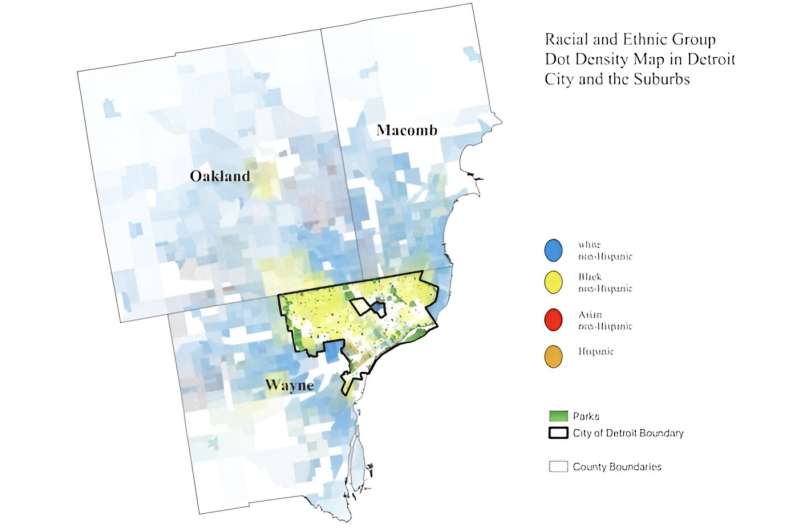
As a sociologist who studies issues related to urban sociology and race and ethnicity, I wanted to know more about where different groups were living around the region. I examined data from the U.S. Census Bureau to explore where racial and ethnic groups live in the city of Detroit, and how much the different groups mix.
Focusing on racial and ethnic groups that made up at least 1% of the population, and using the most up-to-date publicly available data, I found the city of Detroit's overall population dropped by 11.3% between 2010 and 2022. Over the same period, the population of the suburban tri-county metro area increased by 3.5%.
Both the city and the suburbs became home to notably more Asian, Hispanic and multiracial people, meaning the area became more diverse overall.
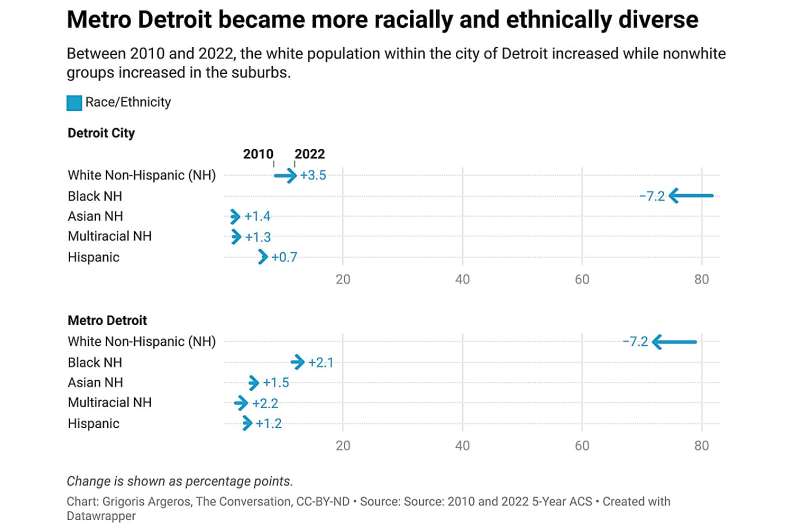
The population of people who identified as white and non-Hispanic grew by 41% in the city but dropped by 9% in the suburbs.
While white people were moving into the city of Detroit, Black people were moving out. The Black population dropped 9% in the city and grew 19% in the suburbs.
Here's how these shifts affected the way different groups experience living in Detroit and the city's suburbs.
The rise in segregation may be linked to the initial stages of adjusting to a new environment for recent Asian and Hispanic immigrants. However, immigration is a complex issue, and many factors influence patterns of segregation.
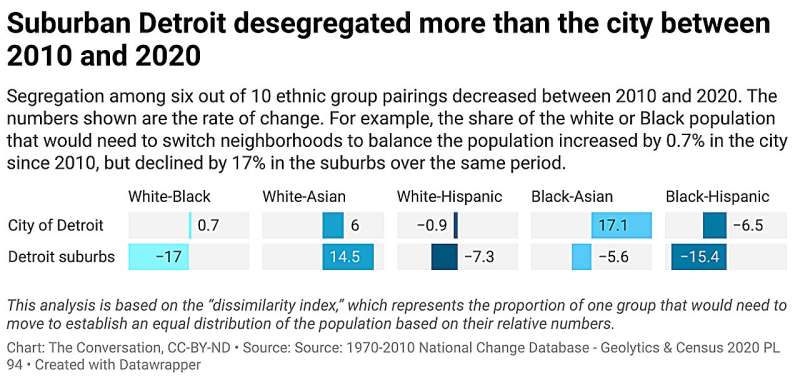
It remains to be seen how these patterns will continue to evolve as Detroit and its suburbs navigate the city's post-bankruptcy recovery and the region's broader sociodemographic and economic structural changes.
Future census data, which will include a new race and ethnicity category for people of Middle Eastern and North African origins, will provide us with more nuance on the changing neighborhood demographics and diversity of the Detroit metro area.
Provided by The Conversation
This article is republished from The Conversation under a Creative Commons license. Read the original article.