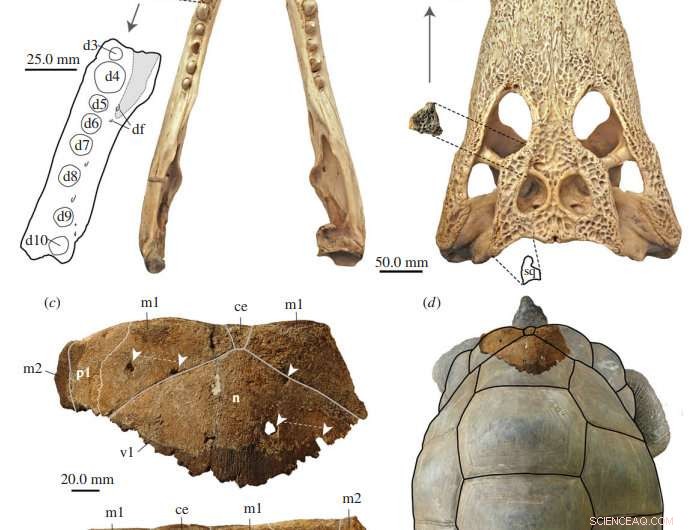
Size comparison of crocodylian and gianttortoiseremains. Credit: Royal Society Open Science (2018). DOI: 10.1098/rsos.171800
An international team of researchers has found evidence that suggests the giant tortoises living on the Aldabra Atoll in the Seychelles may have once had to watch out for crocodile attacks. In their paper published in the journal Royal Society Open Science, the group describes fossil evidence they found on the atoll that suggests crocodiles large enough to cause harm may have once feasted on the giant tortoises.
Today, the giant tortoises that live on Aldabra Atoll pass their days relatively stress-free due to an absence of predators. Their thick, dome-shaped shells offer them a very secure defense against creatures that might seek to harm them. But their peaceful existence is also thanks to laws that ban humans from harming them, and perhaps events that led to the demise of crocodiles that were big enough to attack them.
The researchers report that during a visit to the atoll, they found parts of giant fossilized tortoise shells with large tooth bite marks on them. More importantly, they also found a jawbone that had once belonged to a large ancient crocodilian—one that was bigger than those represented by previously found fossils. Testing showed that both fossils were from a time period approximately 90,000 to 125,000 years ago—putting them in the late Pleistocene. The size of the fossilized jawbone, the team concluded, suggested that the crocodile would have been larger than the others that had lived on the atoll, but smaller than modern Nile or saltwater crocodiles. They further estimated by examining the jawbone that the crocodile would have been approximately 11.5 feet long—big enough to tear limbs or a head from an exposed tortoise. The tortoise would have weighed approximately 550 pounds.
The researchers suggest that the bite marks on the tortoise shell indicate one of two possible scenarios. In the first, the croc had hidden itself beneath the water and then pounced when it saw the tortoise stretch its neck out to get a drink of water. The other possibility was that the tortoise died from another cause and the crocodile left marks as it attempted to get at the remains inside the shell.
© 2018 Phys.org