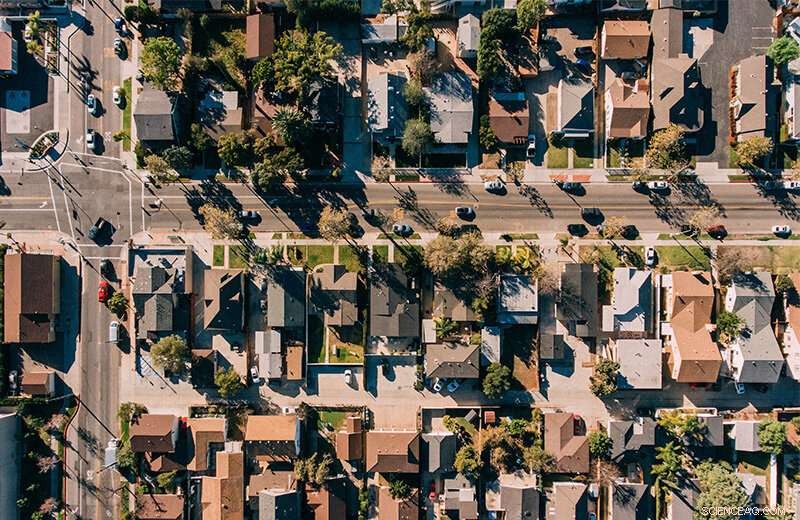
Low-income residents may be forced to live in neighborhoods plagued by pollution and crime, and lacking quality schools. Credit: Unsplash
Metro areas in the United States have become increasingly unaffordable to residents, especially Black and Latino Americans, finds a new report from the USC Dornsife Equity Research Institute (ERI), published by the National Equity Atlas.
Between 2013 and 2019, the number of metro areas having no zip codes with housing that is affordable to working class renters increased from 14% to 42%. More than 80% of the country's most populous regions saw an average 12% drop in affordability. ERI co-produced the report with nonprofit PolicyLink.
Without access to options, low-income households are forced to live in neighborhoods plagued by pollution and high-crime, and with few amenities such as quality schools or parks. For low-income families squeezed out of resource-rich neighborhoods, their children face an uphill battle when breaking out of poverty.
It's also a concern for businesses. With less and less affordable housing in metro areas, companies struggle to find and retain workers. Already, employers are attempting to mitigate the problem by purchasing and building affordable housing for their workers, with mixed results.
Renters across income brackets and race/ethnicities face a shrinking number of affordable neighborhoods
Differences in median-income worsened neighborhood choices for Black and Latino families
The neighborhoods that remain affordable are low-opportunity, especially for Black households
"Housing unaffordability is both a product and driver of racial inequities, and it's only getting worse. Working class Black and Latinx households continue to experience de facto segregation as they are unjustly priced out from high-opportunity areas that would improve their lives and generations to come," says Thai V. Le, Turpanjian Postdoctoral Fellow in Civil Society and Social Change at the Equity Research Institute and a co-author of the report.
"However, as important as it is to bring affordable housing to opportunity-rich neighborhoods, we must also bring opportunities and resources to working-class neighborhoods where community ties are."
The report recommends a variety of potential solutions to improve conditions.