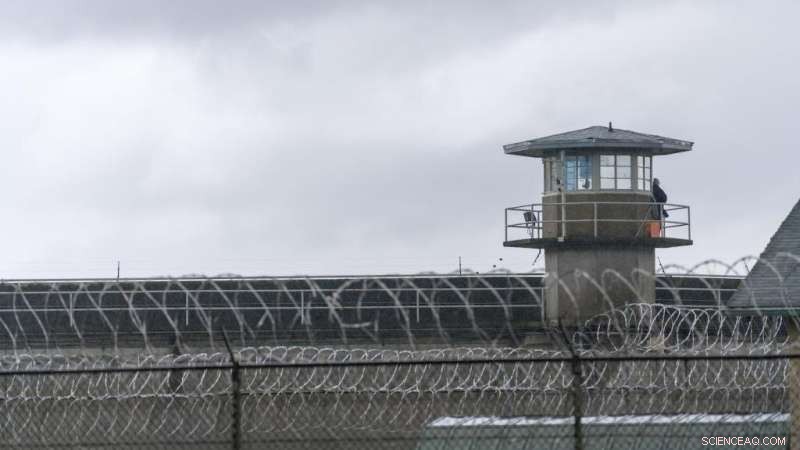
Incarcerated workers in the U.S. generate billions of dollars worth of goods and services while toiling under unjust conditions, according to a new report from the University of Chicago Law School’s Global Human Rights Clinic and the American Civil Liberties Union. Credit: Shutterstock.com
Incarcerated workers generate billions of dollars worth of goods and services annually but are paid pennies per hour without proper training or opportunity to build skills for careers after release, according to a comprehensive nationwide report released by the University of Chicago Law School's Global Human Rights Clinic and the American Civil Liberties Union
The first-of-its-kind report, "Captive Labor: Exploitation of Incarcerated Workers," examines the use of prison labor throughout the U.S. and highlights how incarcerated workers' labor helps maintain prisons and provides vital public services. Captive Labor also calls for far-reaching reforms to ensure prison labor is truly voluntary and that incarcerated workers are paid fairly, properly trained, and able to gain transferable skills.
"As our report describes in detail, the labor conditions of incarcerated workers in many U.S. prisons violate the most fundamental human rights to life and dignity," said Clinical Prof. Claudia Flores, the director of the Global Human Rights Clinic. "In any other workplace, these conditions would be shocking and plainly unlawful. The many incarcerated workers we interviewed told us story after story of inadequate equipment and training, punishments doled out if workers refused to labor, and an overall helplessness to a government institution functioning as both jailer and boss."
Key findings include:
"The United States has a long, problematic history of using incarcerated workers as a source of cheap labor and to subsidize the costs of our bloated prison system," said Jennifer Turner, principal human rights researcher with the ACLU's Human Rights Program. "Incarcerated workers are stripped of even the most minimal protections against labor exploitation and abuse. They are paid pennies for their work even as they produce billions of dollars for states and the federal government. It's past time we treat incarcerated workers with dignity. If states and the federal government can afford to incarcerate 1.2 million people, they can afford to pay them fairly for their work."
The exploitation of incarcerated workers is rooted in the "exception clause" to the 13th Amendment, which bars slavery except for people who have been convicted of crimes. In many states—and in the United States Constitution—exception clauses allow for workers in prisons to be exploited, underpaid, and excluded from workplace safety protection laws. Worse, the exception clause in the 13th Amendment disproportionately encouraged the criminalization and re-enslavement of Black people during the Jim Crow era, and we still feel the impacts of this systemic racism to this day in the disproportionate incarceration of Black and Brown community members.
To combat the exploitation of incarcerated workers, the report makes several recommendations, including:
Captive Labor: Exploitation of Incarcerated Workers comes more than two years into the COVID-19 pandemic, during which incarcerated workers faced especially brutal working conditions and yet were denied early access to vaccines in 16 states. Incarcerated people were forced to produce masks, hand sanitizer, and other personal protective equipment. Others were forced to launder bed sheets and gowns from hospitals treating COVID patients, transport bodies, and dig graves. Many report being forced to continue working but not able to have visitors and having their parole date pushed back if they refuse to work. More than a third of incarcerated people have contracted COVID-19 since the pandemic started and more than 3,000 have died.
"The U.S. prison system claims to offer rehabilitation to its population, but prison labor programs do just the opposite: they degrade, dehumanize and further cripple incarcerated workers," said Mariana Olaizola Rosenblat, a UChicago lecturer in law and fellow at the Global Human Rights Clinic. "The many incarcerated workers we interviewed voiced a strong desire to engage productively in society under dignified conditions. It's time for the U.S. government and prison authorities to give them this chance, not merely rhetorically but in practice."
The Law School's Global Human Rights Clinic partners with human rights and civil rights organizations around the world to conduct investigations, develop strategies, and advocate for human rights before international, national, and local decision makers and stakeholders.
The Captive Labor report reflects the work of three generations of GHRC students, faculty and staff. From 2018 to 2022, the clinic team conducted extensive research and completed drafting of a report highlighting the violations of the human rights of incarcerated workers in the United States. They analyzed state and federal laws, policies, and practices that result in these violations of international human rights standards, and detailed the multiple exploitative aspects of prison labor as recounted by incarcerated workers themselves. The clinic also provided a set of recommendations for federal, state and local governments, state departments of corrections, the Federal Bureau of Prisons, correctional authorities, and private companies involved in prison labor.
In addition to contributing to the drafting and research of the report, the clinic filed FOIA requests in 50 states, surveyed more than 100 workers currently behind bars in three states (Illinois, Louisiana and California), completed a fact-finding trip to Louisiana in March 2020, and conducted 65 interviews with key stakeholders including experts, formerly incarcerated individuals, representatives of advocacy organizations, academics, and leaders of reentry organizations across the country.