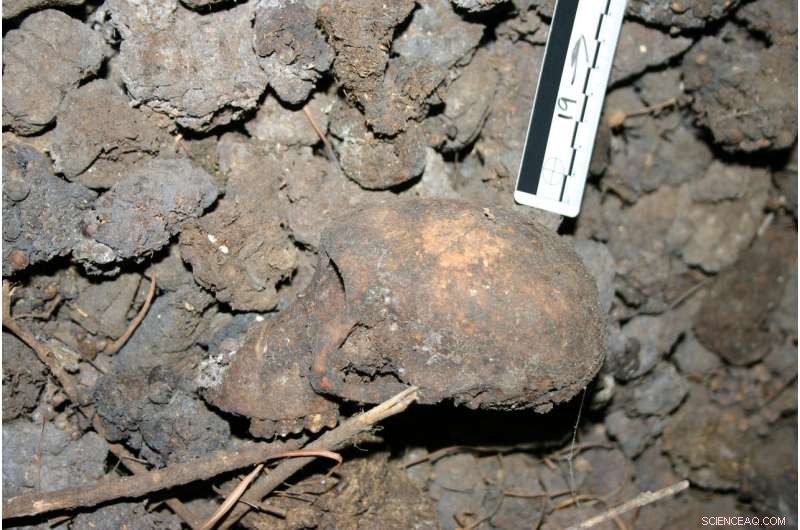
Side view of a baboon cranium from Misgrot Cave, South Africa. This is one of the comparative assemblages the authors used in the analysis. Credit: PNAS
An international team of researchers has used a machine learning algorithm to assess whether hominin bones found in caves were placed there as part of a burial service by early human ancestors. In their paper published in Proceedings of the National Academy of Sciences, the group describes the factors they fed into the algorithm, and what it revealed.
One of the defining characteristics of humans is our ability to fully understand the nature of our own mortality—we are all going to die, and we all know it. But when did humans evolve to the point where this became so? Some researchers have suggested that it goes back several hundred thousand years. As evidence, they claim that hominin fossils found in caves in Spain (Sima de los Huesos) and South Africa (Dinaledi Chamber), both from the Middle Pleistocene, were put there by their fellow hominins as a part of a mortuary service, which, of course, suggests a possible understanding of the finality of death and the possibility of an afterlife. Not everyone agrees with that assessment, however. Thus, new ways to test for the possibility arise periodically. In this new effort, the researchers turned to machine learning to shed some light on the debate.
To assess whether the bones at the two sites were placed there intentionally or if they arrived by some other means, the researchers used a learning algorithm to analyze data regarding other burial sites, including those of modern humans, other primates and archaic humans. They then programmed the algorithm to assign the sites to categories such as scavenged corpses, undisturbed human corpses, etc. Then they added data from the caves in Spain and South Africa to see how the algorithm would categorize them.
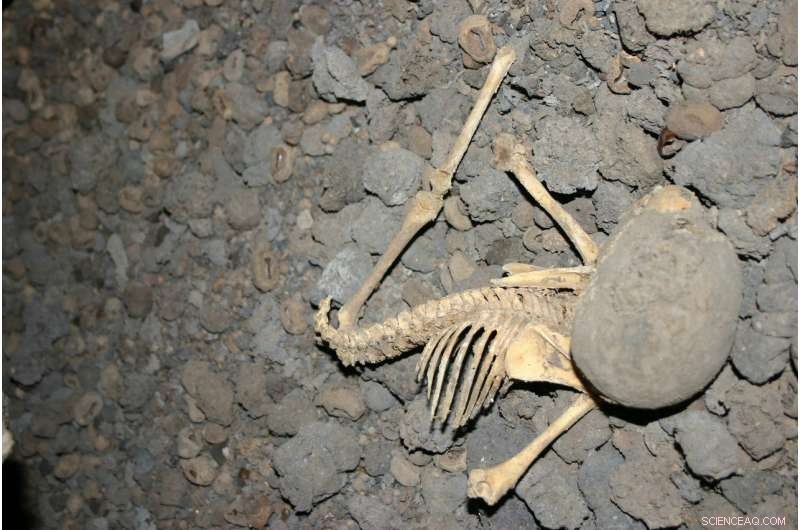
Partial baboon skeleton from Misgrot Cave, South Africa. This is one of the comparative assemblages the authors used in the analysis. Credit: PNAS
The researchers report that the algorithm assigned both sites to scavenged corpses, which suggests that the bones made their way into the caves via carrion animals carrying them to feed in relative peace. They note that the algorithm did not rule out the possibility of early hominins conducting burial services in general, just in these two cases.
The findings by the team will not settle the debate, of course. Research surrounding the remains in the two caves will undoubtedly continue, with each side using evidence, such as the learning algorithm, to bolster their case.
© 2018 Phys.org