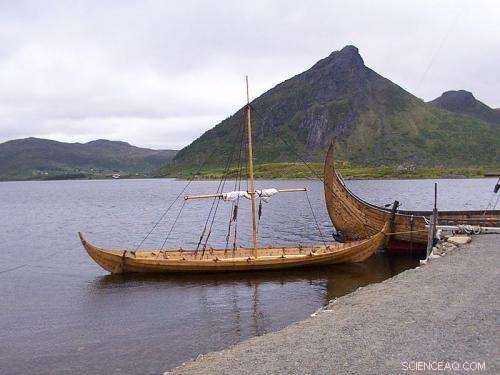
The "Lofotr" viking ship and the smaller "femkeiping". Both recosntructions based on excavations from the Gokstad find. Credit: Geir Are Johansen/Wikipedia
A pair of researchers with ELTE Eötvös Loránd University in Hungary has run computer simulations that suggest that tales of Vikings using a sunstone to navigate in cloudy weather might be true. In their paper published in Royal Society Open Science, Dénes Száz and Gábor Horváth describe the factors that contributed to their simulations and what they found by running them.
For the time period 900 to 1200 AD, Vikings, by nearly all accounts, ruled the northern Atlantic. Their skill in building strong boats and in navigation allowed them to travel throughout the North Atlantic. Prior research has suggested the Vikings used a type of sundial to navigate, which was apparently quite accurate. But what did they do when it was cloudy or foggy? Viking tales passed down through the generations claimed it was through the use of sunstones, which allowed Viking navigators to find the sun even on cloudy days. But proving the tales true has been problematic—no sunstone has ever been found on or near a Viking shipwreck. A crystal was found on a 16th-century English shipwreck in 2002—and English sailors could have learned to use them from the Vikings—but much stronger evidence is needed.
Most who have studied the possibility of a sunstone assume it was a form of crystal—it has been noted that some crystals, such as those formed from calcite, cordierite, and tourmaline, can split sunlight into two beams even when it is cloudy—and when the crystal is turned, splitting the two beams at the same brightness, a navigator could see the polarized rings around the sun—effectively showing its placement in the sky.
Száz and Horváth noted that thus far, no one has actually tested the use of such crystals to navigate from Norway to Iceland, Greenland, or even North America, likely because one or two excursions would not be enough to prove its usefulness, especially if it was not cloudy very often during such a journey. A better approach, they thought, would be computer simulations of multiple trips from one single point in Norway to one point in Greenland. After inputting data describing such trips, the researchers ran the simulations multiple times over the course of two specific virtual days, the spring equinox and the summer solstice. They ran the trials for different types of crystals and with differing intervals between sunstone tests.
The researchers report that they found mixed results overall, depending on which type of crystal was used and how often a mariner made a sun reading. In the best-case scenario, however, they found that using a cordierite crystal for a minimum of every three hours was approximately 92.2 to 100 percent accurate.
© 2018 Phys.org