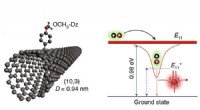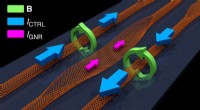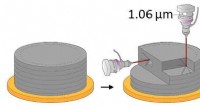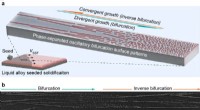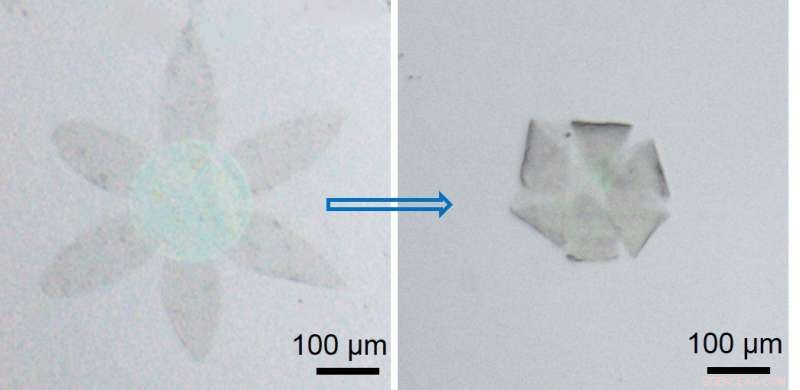
Temperature induced self-folding of a functionalized graphene flower. Credit: Weinan Xu, Johns Hopkins University
(Phys.org)—A team of researchers with Johns Hopkins University and MIT has found a way to cause flat sheets of graphene to self-fold into 3-D geometric shapes. In their paper published on the open access site Science Advances, the group explains how they prepared the sheets and then used heat to cause them to fold.
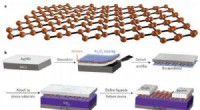
Graphene has been in the news a lot over the past decade, as its unique properties could lead to the development of a host of new applications. Some likely applications include biosensors and wearable electronics. Before such devices can be created, however, a means must be found to create three dimensional objects from flat sheets of the material. Up until now, most methods have involved etching or applying the sheets to a substrate that conforms to a desired shape. Both methods leave much to be desired; thus, researchers continue to seek a better solution. In this new effort, researchers have developed a micropatterning technique that leads to the flat graphene sheets bending along predesignated lines when heat is applied, causing the sheet to form into shapes—much like origami forms when manipulated by human hands.
One of the main benefits of the new approach is that it preserves the intrinsic properties of the graphene, which has been the goal all along—after all, what is the point of using graphene in the first place if you have to diminish its unique attributes to make it conform to a desired shape? Another benefit is that the creases can cause a band gap in the graphene, which graphene notoriously lacks in its natural state.
The team notes that the technique is also compatible with traditional lithography and can be applied at the wafer scale. Also, it is highly parallel, which means it should not present manufacturing problems. They also report that they tested their technique by creating 3-D shapes that were used to hold living cells and nonlinear resistors. They also used one in the creation of a transistor device. By creating such useful 3-D structures, the team believes they have shown that their technique could be used to build viable wearable electronic devices and sensors that could be used inside of a living organism.
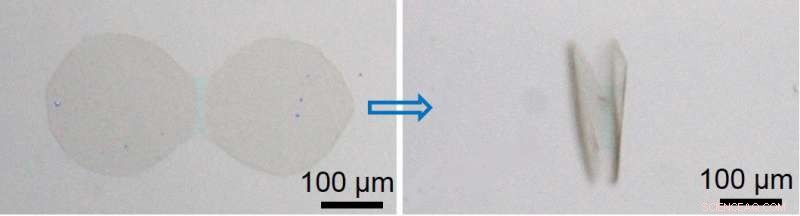
Temperature induced self-folding of a functionalized graphene dumbbell. Credit: Weinan Xu, Johns Hopkins University
© 2017 Phys.org