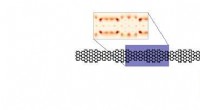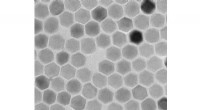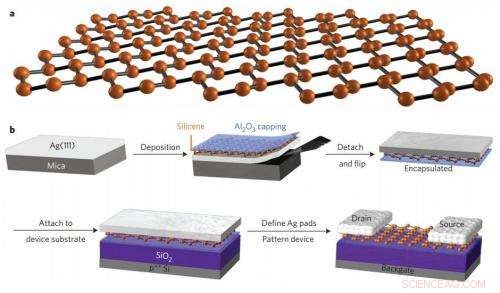
Schematics of silicene and its synthesis–transfer–fabrication process. a, Buckled honeycomb lattice structure of silicene. b, Silicene encapsulated delamination with native electrode (SEDNE) process, which includes the following key steps: epitaxial growth of silicene on crystallized Ag(111) thin film, in situ Al2O3 capping, encapsulated delamination transfer of silicene, and native contact electrode formation to enable back-gated silicene transistors. Credit: Nature Nanotechnology (2015) doi:10.1038/nnano.2014.325
(Phys.org) —A team of researchers with members from Italy and the U.S. has succeeded in building a transistor based on silicene, for the very first time. In their paper published in the journal Nature Nanotechnology, the team describes how they were able to get the notoriously finicky material to cooperate.
Silicene is where silicon is made in one atom-thick sheets—like graphene, it has proven to have fantastic electrical properties, which means it could be useful in future electronics, particularly as researchers continue to attempt to make faster or smaller computer chips. The problem with silicene is that it is very difficult to make and even more difficult to work with once a sheet is at hand. It has been only eight years since physicist Lok Lew Yan Voon published theories about how silicene would perform, and since then, various groups have tried creating the material, most finding little to no success. Those groups that have succeeded have found that getting the sheets to behave has been a serious hurdle to using it for any practical purposes. In this new effort, the researchers report that not only have they been able to create the material, but they have found a way to tame it enough to allow them to create tiny transistors.
To get the nanosheets to cooperate the researchers first grew some sheets of it on a very slim base of silver that had been topped with aluminum oxide. Once grown, the silicene sheet was peeled off its base and placed silver side up on a silicon dioxide wafer. The silver was then fashioned to make electrical contacts allowing the sheet to be used as a transistor. The team reports that they built several such transistors and that they were stable when used in a vacuum. They also report, that thus far, the performance of the silicene has lived up to the theories that predicted its properties.
Though the team has technically created a transistor based on silicene, it is still not clear if such a process would be amendable to porting to a commercial application. Much more research will have to be done before that is determined. If it does work out, the team believes it would be easier to use silicene in future electronics than graphene, because so much of chip design is already silicon based.
© 2015 Phys.org