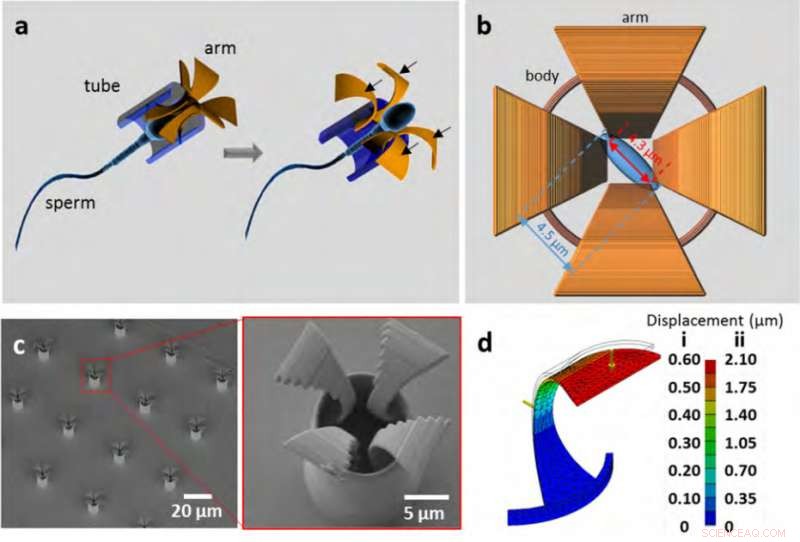
(a) Schematic illustration of the sperm-hybrid micromotor and the sperm release process. Black arrows represent the reactive force on the arms upon hitting an obstacle. (b) Top view of the tetrapod microstructure with schematic sperm head (c) SEM images of an array of printed tetrapod microstructures. (d) Simulation results demonstrating the deformation of one single arm. Yellow arrows represent the applied forces. (i) Applied force is 128 pN from a motile, non-hyperactivated sperm. (ii) Applied force is 450pN from a hyperactivated sperm. Credit: arXiv:1703.08510 [physics.med-ph]
(Phys.org)—A team of researchers with the Institute for Integrative Nanosciences in Germany has tested the possibility of using sperm cells to deliver drugs to cancerous tumors in female patients. In their paper uploaded to the preprint server arXiv, the group describes how such a technique might work, their initial test results and what they learned from their experiments.
In recent years, medical researchers have been focusing on developing carrier systems for delivery of chemicals to targets inside the body to treat ailments such as cancer, but thus far, it has been slow going due to a variety of issues such as the body responding in unhelpful ways or targets such as tumors putting up a tough front. In this new effort, the researchers looked into the idea of using a natural carrier to deliver helpful drugs to specified targets—sperm cells delivering drugs guided to tumors and other problem sites in the female reproductive tract.
While it is known that sperm cells will swim around in the vagina searching for an egg to fertilize, and in some cases, have been known to swim up and fertilize eggs still in the fallopian tube, the randomness of their behavior was deemed too untenable for drug delivery—the team wanted to be able to steer individual sperm cells. To accomplish that feat, they coaxed sperm cells to swim into a very tiny helmet coated with iron that would adhere to its head. The sperm could then be steered using an external magnet. The helmet was designed with a quick-release mechanism that allowed it to dislodge from the sperm when it ran head first into something, such as a tumor cell, allowing the sperm cell to penetrate the tumor cell the same way it would an egg, delivering the drug. The researchers also found that they could cause a sperm cell to absorb a cancer drug simply by soaking it in a solution containing the drug.
The researchers tested their idea using bull sperm on a tiny track in their lab. They report that they were able to successfully move the sperm cell to a desired location, HeLa cells and HeLa spheroids—stand-ins for tumor cells. They report also that the helmet caused the sperm to swim 43 percent more slowly than normal. Though the test results proved impressive, there are many hurdles to overcome before such a technique could actually be used in humans—first and foremost, preventing accidental pregnancies. There is also the issue of what happens to the abandoned helmets (thousands would be left behind) and whether a sperm cell could be steered around inside the human body. And then there is the problem of obtaining the sperm.
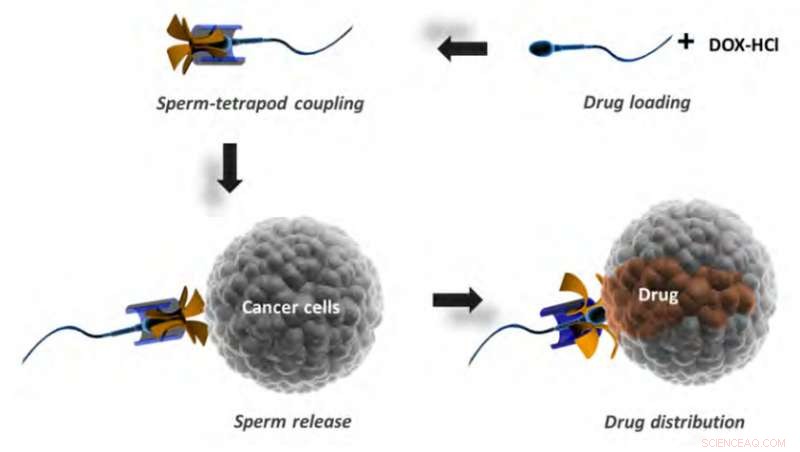
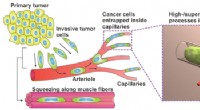
Schematic depicting tumor targeted drug delivery by a sperm-hybrid micromotor under magnetic guidance with mechanical sperm release trigger. Credit: arXiv:1703.08510 [physics.med-ph]
© 2017 Phys.org