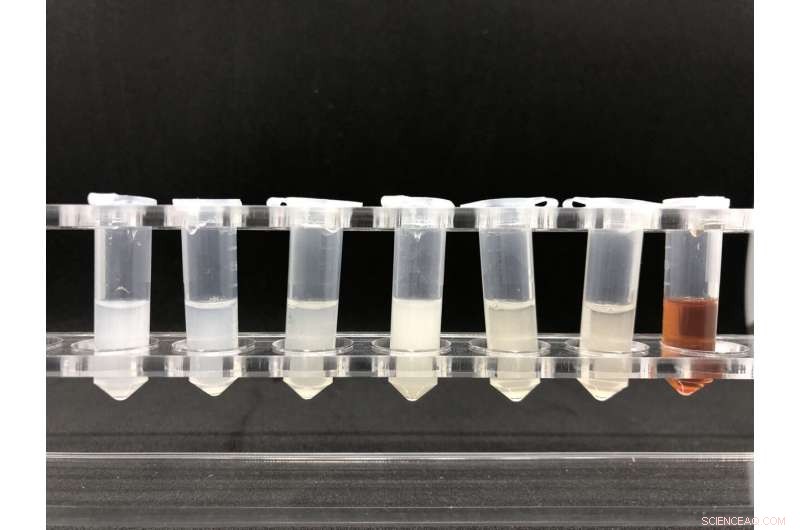
The prepared CdTeQDs/2DBWO photocatalyst with different proportions. Credit: Yang Pengqi
A research team led by Prof. Wu Zhengyan from the Hefei Institutes of Physical Science of the Chinese Academy of Sciences (CAS) has recently introduced a high-efficiency Z-scheme photocatalyst to deal with contaminants in water. This new solution has been published in ACS Applied Nano Materials.
In recent years, rapid industrialization has caused increasingly severe environmental pollution. Therein, various organic pollutants in water have become major threats for human health and ecosystem security worldwide. Therefore, an effective treatment approach has become an urgent task for elimination of organic pollutants at present.
In this research, the Bi2WO6(CdTeQDs/2DBWO) photocatalyst with a giant built-in electric field (BEF) was proved to extremely promote the dissociation of exciton and generation of reactive oxygen species. The researchers demonstrated that BEF plays a positive role in photocatalytic process, and the photodegradation efficiency of phenol, rhodamine B and tetracycline by BEF is much higher than that of pure Bi2WO6 under visible light.
Compared with the commercial TiO2 photocatalyst, the self-prepared CdTeQDs/2DBWO photocatalyst has a slight advantage in photocatalytic efficiency for pollutants. However, due to the complicated synthesis process and high cost, there are still some difficulties in the practical application of self-prepared photocatalyst.
This study opens up a new route for designing high-efficiency photocatalysts.
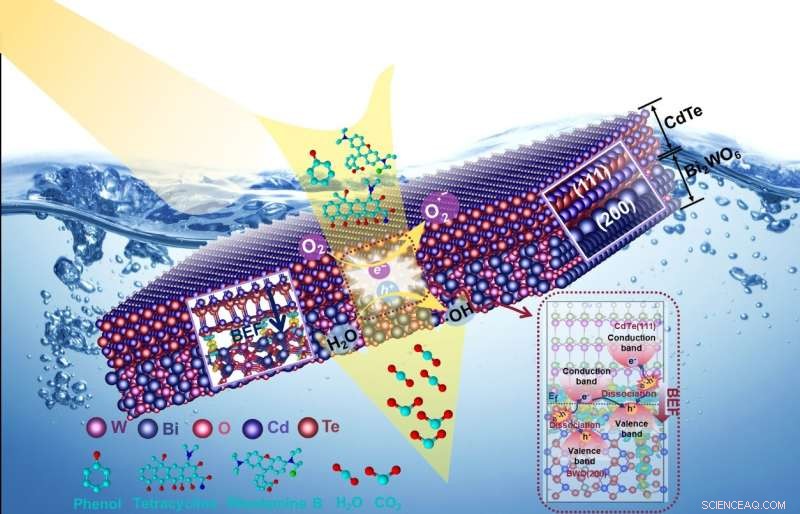
Schematic illustration of photocatalytic degradation mechanism. Credit: Yang Pengqi