(Phys.org) —A team of engineering and physics researchers with members from the U.S., the U.K. and the Republic of Muldova has found that covering a common type of plastic with a graphene coating can increase its conductivity by up to 600 times. In their paper published in the journal Nano Letters, the team describes their new technique and how the coated materials they've created might be used in real world applications.
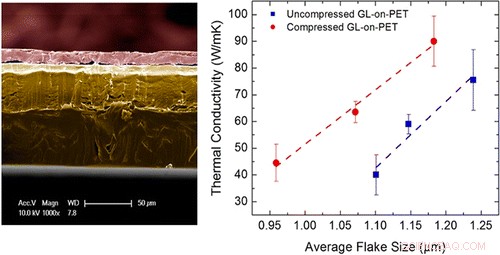
Plastics are not very good conductors of heat—they are generally in the 0.15–0.24 W/mK range—which is a good trait when it's produced as flakes and used as a stuffing inside a winter coat, but not so good when used in electronics that generally need to convey heat away from a source. Engineers would like to use them in more applications however, due to their very low cost, light weight and durability. Conversely, graphene is an excellent conductor of heat (in the 2000–5000 W/mK range) along with its other unique properties, though notably a lot of that improvement is lost when applied to a substrate—it's still much better than plastic though. In this new effort the researchers sought to improve heat conduction in a plastic by applying graphene to its surface.
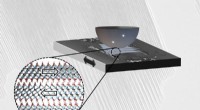
The type of plastic used, PET, is very common—it's used to make soda bottles and a myriad of other products in a nearly limitless variety of shapes. Graphene for the experiment was grown in sheets just a few microns thick and then applied to a thin sheet of PET. The heat conductance (along the surface) of the resultant material was tested using a non-contact optothermal Raman technique where the researchers found the conductance had been increased by approximately 600 times.
The researchers suggest the graphene coated PET could be used in thermal management applications or thermal lighting or even inside electronic devices to help move heat away from heat generating chips.
The team next plans to work on creating models that have more detail and which are based on multiscale simulations that will shed light on which sorts of real-world applications the coated plastics might best be used in.
© 2014 Phys.org