Credit: ACS Nano, DOI: 10.1021/nn304407r
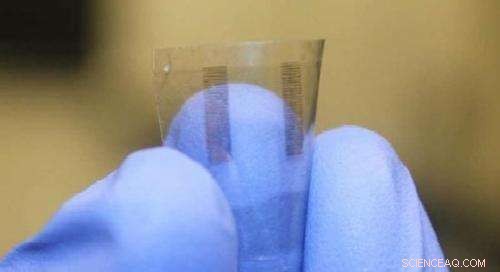
(Phys.org)—Researchers at the University of Maryland have succeeded in creating a transistor using a new kind of paper as a base. As the team describes in their paper published in the journal ACS Nano, they were able to overcome the limitations of ordinary paper by creating very flat nanopaper that allowed for printing a layered transistor.
As part of an effort by many researchers the world over to use renewable resources, scientists have turned to paper as a base for creating electronic devices. To that end, research efforts have yielded such products as paper batteries, light emitting diodes and several types of circuits. Thus far however, efforts to make paper based transistors have been disappointing due to the roughness of ordinary paper—the bumps and valleys can be on the micrometer scale, whereas transistor layers can only tolerate differences of a few hundred nanometers.
To overcome this problem the researchers created nanopaper by treating paper pulp with oxidizing enzymes and mechanically beating it till very flat. The end result is paper that is 84 percent transparent and exceptionally flat—its fibers have an average diameter of just 10nm.
Because the nanopaper is as flat as plastic, the researchers were able to print electronics on it, starting with a base layer of carbon nanotubes. Next a dielectric ink was applied via printing, followed by a coat of semiconducting ink. The transistor was completed by applying another nanotube layer that served as both electrodes and as a means of structural support. In testing the finished product, the researchers found the transistor functioned as planned, and even sustained a loss of just 10 percent efficiency when slightly bent.
The research team acknowledges that their nanopaper based transistor is not yet efficient enough to compete with materials currently in use in electronic devices, but suggests that some tweaking might lessen the wrinkling that occurs with the paper as the ink dries, increasing efficiency. If so, consumers might someday soon find themselves using computers, smartphones, etc., with transistors in them built using a renewable resource—and that might lead to devices that can be easily recycled as well.
© 2013 Phys.org