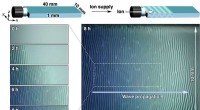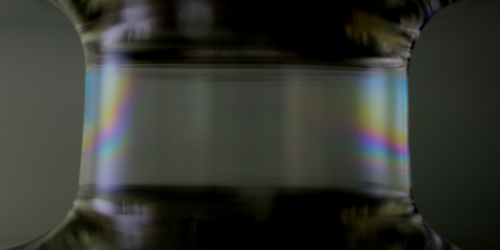
Voltage applied across this cylindrical soap film causes fluid to flow up against gravity in the roughly 100-nanometer-thick film. Credit: O. Bonhomme/Univ. of Lyon/CNRS, via Physics Focus
(Phys.org)—Researchers with Institut Lumière Matière, at the University of Lyon have found that soap film channels can be tuned using an electric charge to cause them to grow thicker or thinner on demand. In their paper published in Physical Review Letters, the team describes how they replaced a physical channel with one made of a thin soap film and found it was tunable due to its elastic walls.
In studying how fluids behave, scientists have found that when they move through a channel, free ions in them tend to stick to channel walls. Applying voltage to the ions causes them to move. That movement rubs the rest of the molecules causing them to move as well. The result is movement of a liquid through a channel due to an electric charge (electro-osmosis). Researchers have found that at the micro level, where the ratio of ions sticking to walls compared to the total amount of fluid is high, the process is particularly strong.
In this new research, the team wondered what might happen if the channel walls were elastic. To find out, they created a soap film (essentially a bubble) between two electrodes separated by just half a centimeter. In this scenario, the soap film existed as two very thin, concentric cylinders of soapy material (water, surfactant and a small amount of potassium chloride to provide the free ions) with ions and water moving freely. Without a charge, gravity would cause the water molecules to fall towards the ground, eventually breaking the film (or popping the bubble). When given a small charge, however, the movement of the ions was sufficiently strong to keep the fluid moving throughout the film, and in some cases was actually strong enough to push it upwards. This was no surprise as other researchers had seen the same result. What was surprising however, was what happened when the voltage was increased.
Prior research had suggested that increasing the voltage would cause the fluid movement rate to increase at a linear rate. Instead, they found the rate increased much faster than predicted. Upon closer inspection they found that this was due to the film becoming thicker, allowing for the movement of more liquid. This finding suggests it might be possible to create fluid micro-gates that can be fine tuned by adjusting the amount of electric charge and/or free ions, resulting in a type of micro-diode.
© 2013 Phys.org