(PhysOrg.com) -- Single molecule electronics is a division of nanotechnology utilizing single molecules as electronic components and its study has the ultimate goal of reducing the size of common electrical circuits. Since 1974, when Mark Ratner and Arieh Aviram from IBM first described how a single molecule was capable of working as a diode in passing current in one direction, research has moved forward in trying to develop a way to use single molecule electronics.
However, the biggest obstacle has been how to wire up this molecule to begin with. Researchers have tried connecting metal electrodes directly, as well as attempting to connect them with conductive polymers, both with little success.
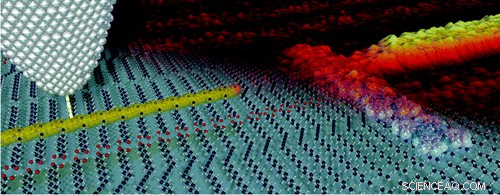
However, according to a study published in the Journal of the American Chemical Society, it appears there may be a breakthrough. Yuji Okawa from the National Institute for Materials Science in Japan and his team have developed a way to bond and wire single molecules. Starting with a monomolecular film of diacetylene on graphite substrate, they deposit phthalocyanine to form nanoclusters. With a tip of a scanning tunneling microscope, they apply a pulsed voltage across the tip and the phthalocyanine surface which initiates a chain polymerization of the diacetylene, forming a polymer nanowire which then bonds to the phthalocyanine molecule.
Okawa now plans to test these phthalocyanine molecules as diodes, with the ultimate goal of creating a single molecule electronic circuit. While the idea of single molecule electronics hitting the market is still a long way off, this new discovery is a breakthrough and gives one step closer to its possibility.
© 2010 PhysOrg.com