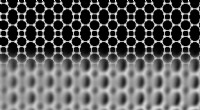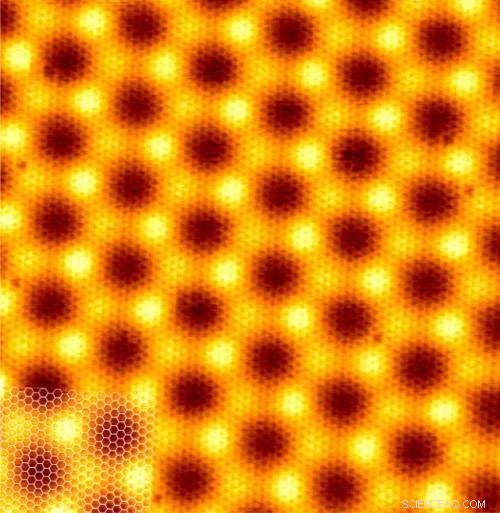
Scanning tunnelling microscopy (STM) image of graphene on Ir(111). The image size is 15 nm × 15 nm. Credit: ESRF
(Phys.org)—A team of researches affiliated with several institutions in the U.K. and Russia has found that chirality in graphene impacts current flow. In their paper published in the journal Nature Physics, the team describes how they developed a method for both detecting and measuring the impact of chirality in graphene and why they believe it could lead to better tunneling electronics devices.
Electrons and other particles have a property that is called chirality, where they exist as being either left or right-handed. In addition, when they exist in an electronic state, it can also be defined as chiral. In this new experiment, the researchers found that the chirality of electrons can have an impact on current flow—they made this discovery by creating a small testing material made of a sheet of four atom thick boron nitride placed between two sheets of graphene. This setup allowed for creating a very controllable type of current flow—when voltage was applied to one of the sheets of graphene, it tunneled its way through the boron nitride to the other graphene sheet where it could be removed. That allowed for noting the right or left-handedness of the electrons as they tunneled through the borone nitride sheet and the states they ended up in. The researchers note that right-handed electrons tended to prefer to make it to right-hand states and vice-versa for the left-handed electrons.
By applying voltage, the team was able to "see" the chirality of the tunneling electrons and its impact on current flow. They also found that applying a magnetic field at a ninety degree angle to the material allowed for seeing the impact even better—doing so served to quantize the motion of the electron, which showed up on a measuring device as energy levels that were unequally spaced apart—a ladder effect. Doing so allowed them to demonstrate that spin, energy and momentum were all conserved in the tunneling process, as was their chirality.
The researchers suggest their findings could lead to efforts that are involved in making better tunneling electronic devices and perhaps to a whole new class of chiralitic electronics.
© 2015 Phys.org