Here's a breakdown of their key characteristics:
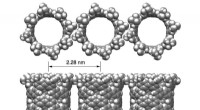
* Size: As mentioned, they are incredibly small, often only a few nanometers in diameter.
* Materials: Nano-springs are usually made from advanced materials like:
* Carbon nanotubes: These are extremely strong and stiff, making them ideal for nano-spring applications.
* Graphene: Another strong and flexible material with excellent electrical conductivity.
* Metallic nanowires: Offer good flexibility and can be used for creating springs with high elastic modulus.
* Properties:
* High spring constant: Nano-springs have incredibly high spring constants, meaning they can withstand a lot of force before deforming.
* High sensitivity: Due to their small size, they can be extremely sensitive to changes in their environment.
* Unique mechanical properties: Their tiny size allows them to exhibit unique mechanical behaviors compared to macroscopic springs.
Applications:
Nano-springs have immense potential in various fields, including:
* Nano-sensors: Their sensitivity makes them ideal for sensing minute changes in pressure, temperature, or other physical parameters.
* Nano-actuators: They can be used as tiny motors or actuators to control movements at the nanoscale.
* Nano-machines: They can be integrated into complex nano-machines for tasks like transporting molecules or carrying out specific functions.
* Bio-medical devices: They can be used for drug delivery, tissue engineering, and other biomedical applications.
* Energy storage: Nano-springs can be incorporated into energy storage devices like batteries to improve their efficiency and lifespan.
Challenges and Future:
Despite their potential, research and development of nano-springs are still ongoing. Some of the challenges include:
* Manufacturing: Creating these incredibly tiny structures reliably and at scale is a major challenge.
* Characterizing their properties: Measuring the mechanical properties of nano-springs is a complex task.
* Integration: Incorporating nano-springs into larger devices and systems requires careful design and engineering.
Overall, nano-springs hold immense promise for revolutionizing various industries. As research advances, we can expect to see increasingly sophisticated applications emerge, pushing the boundaries of what's possible at the nanoscale.