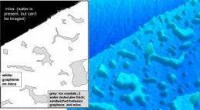
When a liquid droplet is placed on a surface, it will spread out and wet the surface. The shape of the droplet will be determined by the balance between the surface tension of the liquid and the adhesive forces between the liquid and the surface. If the surface is smooth and uniform, the droplet will spread out into a flat circle. However, if the surface is rough or textured, the droplet will be pinned to the surface at certain points and will take on a more irregular shape.
The team's model takes into account the effect of surface roughness on the growth of droplets. The model predicts that the droplet will grow faster in areas where the surface is rougher and slower in areas where the surface is smoother. This is because the surface roughness provides more nucleation sites for the liquid to condense onto, which leads to faster droplet growth.
The team's model could be used to design surfaces that control the growth and shape of droplets. For example, a surface could be textured with a pattern of tiny pillars that would cause droplets to grow into a specific shape. This could be used to create self-cleaning surfaces that repel water droplets, or to create microfluidic devices that control the flow of liquids.
The team's findings are published in the journal Physical Review Letters.