According to Moore's law, the number of transistors that can be packed into a given area of silicon doubles about every two years. This has led to exponential growth in computing power, but it is starting to reach its limits. One way to keep the increases in computer power coming is to use new materials that can be packed more densely than silicon.
Strained silicon is one such material. It is made by growing a thin layer of silicon on top of a layer of another material, such as germanium. This causes the silicon to be stretched, or strained, which changes its electrical properties. Strained silicon can be used to make transistors that are smaller and faster than traditional silicon transistors.
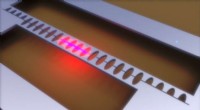
Researchers at the University of California, Berkeley have now shown that strained silicon nanowires can be used to make even smaller and faster transistors. Nanowires are tiny wires made of semiconductor material. They are only a few atoms thick, and they can be packed much more densely than traditional transistors.
The researchers found that strained silicon nanowires can be used to make transistors that are only 5 nanometers wide. This is about 10 times smaller than the transistors that are currently used in most computers. The transistors also operate at much higher speeds than traditional silicon transistors.
This research is a major breakthrough in the field of computer chip technology. It shows that strained silicon nanowires could be used to make computers that are much smaller, faster, and more powerful than current computers.
Benefits of strained silicon nanowires
Strained silicon nanowires offer a number of benefits over traditional silicon transistors. These benefits include:
* Smaller size: Strained silicon nanowires can be made much smaller than traditional silicon transistors. This allows for more transistors to be packed into a given area, which can lead to increased computing power.
* Faster operation: Strained silicon nanowires operate at much higher speeds than traditional silicon transistors. This can lead to improved performance in a variety of applications, such as gaming and video editing.
* Lower power consumption: Strained silicon nanowires consume less power than traditional silicon transistors. This can lead to longer battery life for portable devices, such as laptops and smartphones.
Challenges of strained silicon nanowires
While strained silicon nanowires offer a number of benefits, there are also some challenges associated with their use. These challenges include:
* Fabrication difficulties: Strained silicon nanowires are more difficult to fabricate than traditional silicon transistors. This can lead to higher costs and lower yields.
* Reliability concerns: Strained silicon nanowires are more susceptible to defects than traditional silicon transistors. This can lead to reduced reliability and shorter device lifetimes.
Conclusion
Strained silicon nanowires offer a number of benefits over traditional silicon transistors, but there are also some challenges associated with their use. However, the research in this area is promising, and it is likely that strained silicon nanowires will eventually be used in a variety of applications, such as computers, smartphones, and other electronic devices.