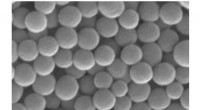
The work reveals how sound waves can precisely control soft nanoparticles, which are less able than their hard counterparts to withstand physical changes in the body as they deliver their cargo.
“Many medicines are fragile, so controlling how these soft nanoparticles transform over time is incredibly important for drug delivery and other medical applications,” said Ming Guo, associate professor of materials science and engineering.
“Using sound gives us a way to non-invasively direct how much and how quickly the drugs should be released, providing a new level of control to target diseases and tissues.
Guo and colleagues reported their acoustic nanomechanical technique today in the journal Advanced Materials.
Liquid-filled nanoparticles have shown great potential to deliver therapies but are more susceptible than solid nanoparticles to physical and biological forces in the body. In addition to premature release of drugs during delivery, scientists also worry that the body may remove the nanoparticles before they reach their intended destination.
A solution could be to tweak the drug-carrying material — such as the polymer, lipid, or metal — to make the nanoparticles tougher. But that often complicates the chemistry of the nanoparticle, making it harder to control how it releases the drug.
A gentler option to control the drug dose is to use external triggers such as light, heat, or ultrasound. But these methods, too, often come with complicated or imprecise controls, Guo said.
“For example, light can be too invasive and can induce undesired side effects,” she said. “And while ultrasound has much higher spatial and temporal resolution, precisely controlling the mechanical effects requires careful engineering of the ultrasound pulses.
In their quest to develop a way to precisely manipulate soft nanoparticles using ultrasound, Guo and colleagues settled on a two-step process.
First, they designed nanoparticles with a liquid perfluorocarbon core surrounded by a lipid bilayer shell, just like a cell membrane.
The team discovered that when the nanoparticles were put in liquid and then pulsed with ultrasound, the sound waves created tiny bubbles within the nanoparticles. Over time, these bubbles expanded, ultimately rupturing the lipid shell and releasing the liquid core.
“Acoustically triggered breakup only occurs when the size and concentration of the bubbles and their growth rate reach a certain threshold,” Guo said. “And we found that the ultrasound parameters could be designed to precisely manipulate these parameters.”
As a proof of concept, the researchers used the technique to deliver a fluorescent payload, which stood in for a drug, into cells in a lab dish. The results suggested the method could be used to control drug delivery inside the body.
For the next steps, Guo’s team plans to focus on how the acoustic parameters could be tailored for controlled release of medicines for different diseases and tissues. “A key challenge will be to ensure that these parameters can be clinically translated,” Guo said. “We are very encouraged by the initial in vitro validation, and that will guide our future work.”