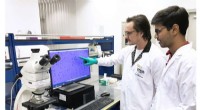
A team of researchers from the University of California, Berkeley, has discovered how a nanocatalyst works at the atomic level. The findings, published in the journal Nature, could lead to the development of new and more efficient catalysts for a variety of chemical reactions.
Catalysts are substances that speed up chemical reactions without being consumed in the reaction. They are used in a wide variety of industrial processes, such as the production of gasoline, plastics, and pharmaceuticals.
Nanocatalysts are catalysts that are made of materials that are only a few atoms thick. They are often more efficient than traditional catalysts because they have a higher surface area, which allows them to interact with more reactants.
The researchers used a technique called scanning tunneling microscopy to study the atomic structure of a nanocatalyst in action. They found that the catalyst was able to speed up a chemical reaction by providing a surface that was ideal for the reaction to take place.
The findings could lead to the development of new and more efficient catalysts for a variety of chemical reactions. This could have a significant impact on a number of industries, including the production of gasoline, plastics, and pharmaceuticals.
The Role of Nanocatalysts in Chemical Reactions
Nanocatalysts play an important role in a variety of chemical reactions. They can speed up reactions, increase yields, and reduce the amount of energy required.
Nanocatalysts work by providing a surface that is ideal for the reaction to take place. The atoms on the surface of the nanocatalyst are arranged in a way that makes it easy for the reactants to come together and react.
The high surface area of nanocatalysts also allows them to interact with more reactants, which can lead to faster reactions and higher yields.
In addition, nanocatalysts can be used to reduce the amount of energy required for a reaction. This is because the nanocatalyst can provide a pathway for the reaction to take place that does not require as much energy.
The Potential Benefits of Nanocatalysts
Nanocatalysts have the potential to revolutionize a variety of industries. They could lead to the development of new and more efficient processes for the production of gasoline, plastics, and pharmaceuticals.
Nanocatalysts could also be used to develop new fuels, such as hydrogen fuel, that are more environmentally friendly.
The potential benefits of nanocatalysts are enormous, and researchers are continuing to explore new ways to use these materials to improve chemical reactions.