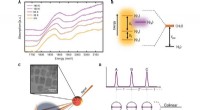
In recent years, there has been growing interest in the study of hot electrons in metallic nanostructures. Hot electrons are electrons that have been excited to energies well above the Fermi level, and they can play an important role in a variety of physical processes, such as plasmonics, photocatalysis, and thermoelectricity.
One of the key questions about hot electrons is whether they can be considered as a non-thermal population of carriers. In a thermal equilibrium, the distribution of electron energies follows a Fermi-Dirac distribution, and the average electron energy is given by the Fermi energy. However, when hot electrons are generated, their energy distribution can deviate significantly from the Fermi-Dirac distribution, and they can have an average energy that is much higher than the Fermi energy.
There are two main mechanisms that can lead to the generation of hot electrons in metallic nanostructures:
* Optical excitation: When a metal nanostructure is illuminated with light, the photons can be absorbed by the electrons in the metal, and this can excite them to higher energy levels.
* Electrical injection: Hot electrons can also be generated by applying a voltage to a metal nanostructure. This can cause electrons to tunnel from one electrode to the other, and this can give them enough energy to become hot electrons.
Once hot electrons have been generated, they can interact with the lattice of the metal nanostructure, and this can lead to the transfer of energy from the hot electrons to the lattice. This process is known as electron-phonon coupling, and it can lead to the heating of the metal nanostructure.
The heating of metal nanostructures by hot electrons can have a number of important consequences. For example, it can lead to changes in the optical properties of the metal nanostructure, and it can also affect the electrical conductivity and thermal conductivity of the metal nanostructure.
The study of hot electrons in metallic nanostructures is a complex and challenging field, but it is also a very important field, as hot electrons can play an important role in a variety of physical processes. By understanding the behavior of hot electrons, we can design metal nanostructures that have the desired properties for a variety of applications.