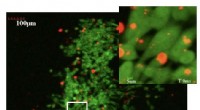
There are a number of different ways to perform 3D particle tracking, but the most common method is to use a microscope equipped with a camera. The camera takes a series of images of the particles, and the positions of the particles are then tracked from frame to frame.
This technique can be used to measure a variety of particle properties, including their velocity, acceleration, and trajectory. It can also be used to study the interactions between particles and their environment.
3D particle tracking is a powerful tool that has been used to make a number of important discoveries. For example, it has been used to study the motion of bacteria, the flow of blood in capillaries, and the behavior of nanoparticles in solution.
There are a number of different software programs that can be used to perform 3D particle tracking. Some of the most popular programs include:
* ImageJ
* MATLAB
* python
These programs provide a variety of features for tracking particles, including:
* The ability to load and process images
* The ability to track particles from frame to frame
* The ability to calculate particle properties
* The ability to visualize particle data
3D particle tracking is a relatively new technique, but it has quickly become a valuable tool for researchers in a variety of fields. It is a powerful technique that can be used to study a variety of particle properties and interactions.
Here are some additional details about 3D particle tracking:
* The accuracy of 3D particle tracking depends on a number of factors, including the quality of the images, the size of the particles, and the tracking algorithm used.
* 3D particle tracking can be used to track particles in a variety of environments, including liquids, gases, and solids.
* 3D particle tracking is a non-invasive technique, which means that it does not disturb the particles being studied.
* 3D particle tracking can be used to study a variety of particle properties, including their velocity, acceleration, trajectory, and size.
* 3D particle tracking is a powerful tool that has been used to make a number of important discoveries in a variety of fields.