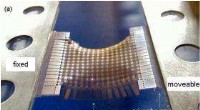
One of the most important advantages of LCEs is their ability to undergo large and reversible deformations in response to external stimuli. This makes them ideal for applications where high actuation force and strain are required, such as artificial muscles or soft robotics. For example, LCE-based actuators have been used to create robotic grippers, miniature pumps, and even artificial muscles for biomedical applications.
Another key advantage of LCEs is their optical properties. They can exhibit birefringence, which means that they have different refractive indices for light polarized in different directions. This property can be used to create a variety of optical devices, such as lenses, polarizers, and beam splitters. LCEs have also been used to develop advanced display technologies, such as flexible displays and holographic displays.
In addition to their actuation and optical properties, LCEs also exhibit a number of other interesting properties, such as self-healing, shape memory, and electrical conductivity. These properties make them suitable for a wide range of applications beyond artificial muscles and optical devices. For example, LCEs have been investigated for use in sensors, energy harvesting, and biomedical engineering.
Despite their potential, LCEs still face a number of challenges that need to be addressed before they can be widely adopted in practical applications. These challenges include improving their mechanical strength, stability, and response time. However, ongoing research is making significant progress in addressing these challenges, and LCEs are expected to play an increasingly important role in a variety of technological applications in the near future.
In summary, liquid crystal elastomer research is paving the way for new applications and practical devices thanks to their unique combination of properties, including large and reversible deformations, optical properties, and additional functional properties. As research continues to address the challenges associated with LCEs, they are expected to find applications in a wide range of fields, including robotics, optics, sensors, and biomedical engineering.