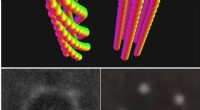
One of the challenges with nanopore DNA sequencing is that the pores are very small, and the DNA molecules can be difficult to thread through them. This can lead to errors in the sequencing data.
A team of researchers from the University of California, San Diego, has developed a new simulation method that can help to overcome this challenge. The simulations show that the DNA molecules can thread through the pores more easily if they are coated with a layer of water molecules.
The researchers believe that this new finding could lead to improvements in nanopore DNA sequencing technology, making it more accurate and reliable.
Nanopore DNA sequencing works by passing a DNA molecule through a tiny pore in a membrane. The pore is so small that only single-stranded DNA molecules can fit through. As the DNA molecule passes through the pore, it disrupts the electrical current that is flowing through the membrane. This disruption is detected by a sensor, and the sequence of the DNA molecule can be determined by analyzing the pattern of disruptions.
One of the challenges with nanopore DNA sequencing is that the pores are very small, and the DNA molecules can be difficult to thread through them. This can lead to errors in the sequencing data. Another challenge is that the DNA molecules can be damaged as they pass through the pore, which can also lead to errors.
The new simulation method developed by the researchers from the University of California, San Diego, shows that the DNA molecules can thread through the pores more easily if they are coated with a layer of water molecules. This is because the water molecules help to lubricate the DNA molecule and reduce the friction between the DNA molecule and the pore.
The researchers believe that this new finding could lead to improvements in nanopore DNA sequencing technology, making it more accurate and reliable.
Nanopore DNA sequencing has a number of potential applications, including:
* Rapid sequencing of DNA from pathogens, which could help to diagnose diseases more quickly.
* Sequencing of DNA from individual cells, which could help to identify genetic mutations that are associated with diseases.
* Sequencing of ancient DNA, which could help to shed light on the history of human evolution.
Nanopore DNA sequencing is still under development, but it has the potential to revolutionize the field of DNA sequencing.