Classical Physics:
* Particles as point-like objects: Classical physics views particles as tiny, localized objects with definite positions and momenta. This is the foundation of Newtonian mechanics, where we can pinpoint the exact location and velocity of a particle at any given time.
* Deterministic: Classical physics is deterministic, meaning that if we know the initial conditions of a system (position and momentum of all particles), we can precisely predict its future behavior.
Quantum Mechanics:
* Wave-particle duality: Quantum mechanics introduces the concept of wave-particle duality, meaning particles exhibit wave-like properties. The wave nature of particles is described by a wave function, often denoted by Ψ.
* Probability interpretation: The wave function Ψ itself isn't a physical quantity; instead, its square modulus, |Ψ|², represents the probability density of finding the particle at a given location.
* Uncertainty principle: This principle states that we cannot simultaneously know both the position and momentum of a particle with absolute certainty. This is a fundamental limitation of quantum mechanics and contrasts sharply with the deterministic nature of classical physics.
* Superposition: Quantum mechanics allows particles to exist in a superposition of multiple states simultaneously. This means a particle can be in multiple locations at once, with the probability of finding it at each location determined by the wave function.
Key Differences:
* Location: In classical physics, a particle has a definite, well-defined position at any given time. In quantum mechanics, a particle's location is described by a probability distribution, meaning we can only talk about the probability of finding the particle at a certain point.
* Determinism vs. Probability: Classical physics is deterministic, while quantum mechanics is probabilistic. The wave function in quantum mechanics provides information about the probabilities of finding a particle in different locations, not its exact position.
* Wave-like behavior: Classical physics treats particles as point-like objects without any wave-like properties. Quantum mechanics recognizes that particles can exhibit wave-like behavior and describes them using wave functions.
Analogy:
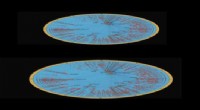
Think of throwing a rock into a pond. Classically, we can track the rock's trajectory and predict its position at any time. Quantum mechanically, we can only say that there's a higher probability of finding the rock's ripples in certain areas of the pond, not its exact location.
In essence, the wave equation in quantum mechanics doesn't give us a precise location of a particle like classical physics does. Instead, it provides a probabilistic description, revealing the likelihood of finding a particle in different locations. This fundamentally changes how we understand the nature of particles and their behavior.