In 1924, de Broglie proposed his famous de Broglie hypothesis, which stated that all matter has wave-like properties. This was a groundbreaking idea that helped to revolutionize our understanding of quantum mechanics.
He suggested that the wavelength of a particle is inversely proportional to its momentum, given by the equation:
λ = h/p
where:
* λ is the wavelength
* h is Planck's constant
* p is the momentum
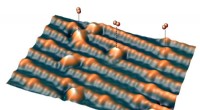
This hypothesis was later confirmed by experiments, such as the Davisson-Germer experiment, which demonstrated the wave-like nature of electrons.