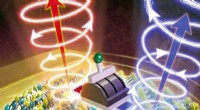
* Forces are vectors: Forces have both magnitude (how strong they are) and direction.
* Net Force: When multiple forces act on an object, the overall effect is determined by the "net force," which is the vector sum of all the forces.
* Changing Direction: To change the direction of a force, you need to apply another force that has a component acting perpendicular to the original force.
Examples:
* Pushing a box: If you push a box horizontally, it moves horizontally. To make it move diagonally, you'd need to push it both horizontally and slightly upwards.
* A ball on a string: A ball swinging in a circle is constantly changing direction. This is due to the tension in the string acting as a force pulling the ball towards the center of the circle.
* A car turning: To turn a car, the driver turns the steering wheel. This changes the direction of the force applied by the tires to the road, causing the car to turn.
Important Note: A force doesn't change direction on its own. It requires another force to alter its direction.