Understanding the Concepts
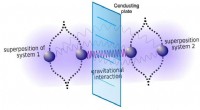
* Newton's Law of Universal Gravitation: This law states that every particle in the universe attracts every other particle with a force that is proportional to the product of their masses and inversely proportional to the square of the distance between their centers.
* Acceleration due to Gravity (g): This is the acceleration experienced by an object due to the gravitational force of a celestial body like the Earth.
Calculations
1. Distance from the Earth's Center: Since we're 2 Earth radii above the surface, the total distance from the Earth's center is 3 Earth radii (1 radius for the Earth itself + 2 radii above the surface).
2. Formula:
The acceleration due to gravity (g') at a distance 'r' from the Earth's center can be calculated using:
g' = (GM) / r²
where:
* G is the gravitational constant (6.674 × 10⁻¹¹ N m²/kg²)
* M is the mass of the Earth (5.972 × 10²⁴ kg)
* r is the distance from the Earth's center
3. Applying the Formula:
Let's assume the Earth's radius (R) is 6,371 km (6.371 × 10⁶ m).
* r = 3R = 3 × 6.371 × 10⁶ m = 19.113 × 10⁶ m
* g' = (6.674 × 10⁻¹¹ N m²/kg² × 5.972 × 10²⁴ kg) / (19.113 × 10⁶ m)²
* g' ≈ 1.11 m/s²
Result:
The acceleration due to gravity at a distance of 2 Earth radii above the surface is approximately 1.11 m/s². This is about one-ninth the acceleration due to gravity at the Earth's surface (approximately 9.8 m/s²).