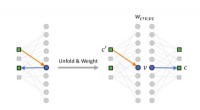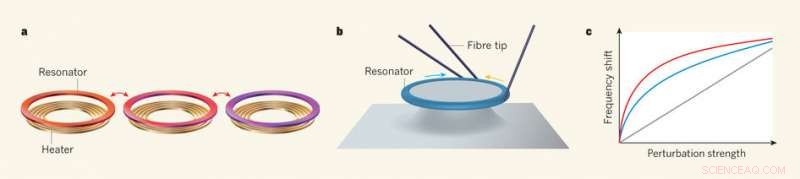
Structures called optical resonators trap light at certain frequencies. When the environment of such a resonator is perturbed, these frequencies shift, which allows optical resonators to be used as sensors. a, Hodaei et al. report a sensor that consists of three ring-shaped resonators that are coupled (red arrows). The authors use gold heating elements both to precisely tune the sensor and to emulate perturbations. b, By contrast, Chen et al. use a single toroidal resonator, and couple light that travels in clockwise (blue arrow) and anticlockwise (yellow arrow) directions. The authors use two fibre tips to tune the sensor and another type of tip to introduce perturbations. c, In conventional sensors, the shift in frequency caused by a perturbation is directly proportional to the strength of the perturbation (grey line). Hodaei et al. and Chen et al. demonstrate that the frequency shift in their sensing devices scales with the cube root (red line) or square root (blue line) of the perturbation strength, respectively. This leads to a dramatic improvement in the scaling of sensitivity of such sensors in comparison to conventional devices. Credit: Mikael C. Rechtsman, Nature 548, 161–162 (10 August 2017) doi:10.1038/548161a
(Phys.org)—Two independent teams working on research aimed at improving optical sensing have used techniques that involve coupling two or more modes of light such that their modes and their corresponding frequencies coalesce, resulting in more sensitivity. In the first effort, a team from Washington University in St. Lois and Otto-von-Guericke University Magdeburg, in Germany, connected three traditional sensors for more precise tuning. In the second effort, a team from the University of Central Florida and Michigan Technological University used just one resonator but coupled light traveling in both directions around it. Both teams have published papers describing their efforts and results in the journal Nature. Mikael Rechtsman with the Pennsylvania State University offers a News & Views piece outlining optical sensing techniques and the work done by the two teams in the same journal issue.
As Rechtsman notes, optical sensors are used in a variety of applications that involve very slight mechanical vibrations or changes in temperature. They are also used when working with nanoparticles or in the analysis of biomolecules. All such sensors have a single problem, however—their performance is limited by the strength of the perturbations under study. In this new effort, both research teams sought to overcome this limitation by coupling modes of light, allowing them to coalesce—this occurs in places called "exceptional points," and they only arise in what are known as Hermitian systems. In such systems, prior research has shown, photon loss is a main feature, as opposed to conventional systems in which the opposite is true. In either case, the result is increased sensitivity, which, of course, translates to more precision.
In the first effort, the researchers connected three ring-shaped sensors together and then added gold heating elements beneath them to fine tune the sensors and to emulate perturbations. In the second effort, the researchers used just one ring-shaped sensor but sent light around it in both directions (both clockwise and counterclockwise) at the same time to cause coalescence. Then, they used a fiber tip to fine tune the sensor and a second tip to cause perturbations.
Both techniques come with a trade-off, Rechtsman notes, between fine-tuning and sensitivity, and there remains the question of whether either or both can be modified to achieve even higher sensitivities.
© 2017 Phys.org