1. Solids:
* Vibrational Motion: Atoms in solids are tightly packed together and held in place by strong bonds. They can't move freely, but they do vibrate back and forth around their fixed positions. The higher the temperature, the faster they vibrate.
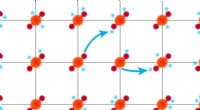
* Diffusion: Even though atoms are tightly packed, they can still slowly move around within the solid. This is called diffusion, and it happens much slower than in liquids or gases.
2. Liquids:
* Translational Motion: Atoms in liquids can move around freely, sliding past each other. They're still relatively close together, but they can move in any direction.
* Rotational Motion: Atoms in liquids can also rotate around their axes.
* Vibrational Motion: They also vibrate, but the vibrations are more vigorous than in solids.
3. Gases:
* Translational Motion: Atoms in gases are far apart and move very rapidly in straight lines. They collide with each other and the walls of their container, but they don't have strong bonds between them.
* Rotational Motion: Atoms in gases also rotate around their axes.
* Vibrational Motion: They also vibrate, but the vibrations are even more vigorous than in liquids.
The Speed of Atomic Motion:
The speed at which atoms move around depends on several factors, including:
* Temperature: Higher temperature means faster atomic motion.
* Mass: Heavier atoms move slower than lighter atoms at the same temperature.
* State of Matter: Atoms in gases move faster than in liquids, and atoms in liquids move faster than in solids.
Key Points:
* Atomic motion is a fundamental concept in chemistry and physics.
* Different states of matter exhibit different types and speeds of atomic motion.
* Temperature, mass, and the state of matter influence the speed and type of atomic motion.
Let me know if you'd like more details on any of these points!