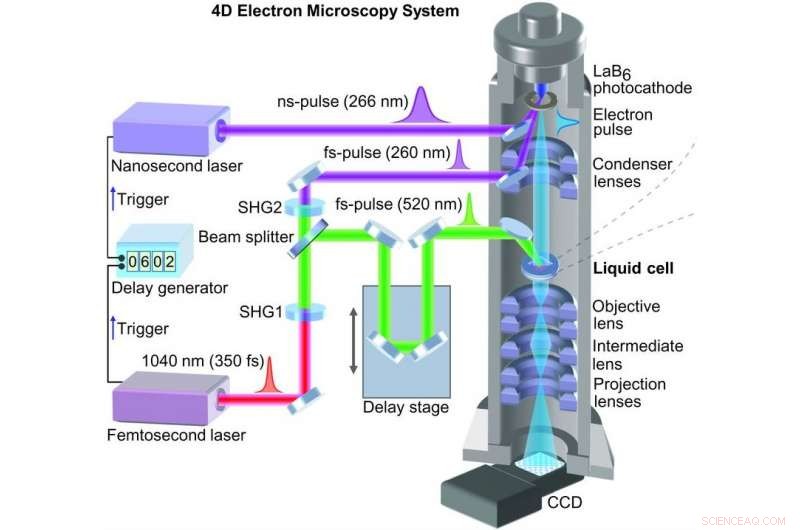
Liquid cell 4D EM. Credit: (c) Science (2017). DOI: 10.1126/science.aah3582
(Phys.org)—A team of researchers at the California Institute of Technology has combined a pulsed laser with an electron gun to capture imagery of suspended nanoparticles moving at nanosecond speeds. In their paper published in the journal Science, the group describes their approach and how they used their apparatus to follow the motion of laser-excited nanoparticles. Peter Baum with Ludwig-Maximilians-Universität offers a Perspective piece on the work in the same journal issue, outlining what they have achieved and describing possible applications for their technique—he also offers some ideas on how it might be improved.
To get a better look at the building blocks of matter, scientists have aggressively pursued better microscopes that allow not just a closer look at things, but short peeks into interactions or reactions that occur at incredibly fast speeds. In this new effort, the researchers sought to combine technologies to capture ultra-fast laser pulses striking a pair of bonded gold nanoparticles suspended in a water solvent.
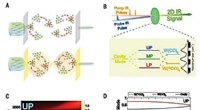
To capture the action, the researchers placed the gold nanoparticle pair in a drop of water, and then squashed the result between plates of silicon nitride, which had been chosen because it allows electrons to pass through but is strong enough to withstand the vacuum pressure inside of an electron microscope. The team then aimed a laser at the nanoparticles and fired a sequence of very rapid pulses at it, causing the water to boil just next to it, exciting the nanoparticles into movement. At the same time, an electron gun fired electrons at the same nanoparticles, creating a flash for image capture. To create the image, the team followed a three-step process: selecting the image using quasi-continuous electron illumination, applying a laser pulse while also applying a probe pulse, and then imaging the end result once again using quasi-continuous electron illumination. By continuously repeating their three-step process, the team was able to gather a data stream of information on the changing position of the nanoparticle pair, which, when combined, comprised a video of sorts depicting the movements of the nanoparticle pair.
The technique needs refinement, as Baum notes, but opens the door to the possibility of creating microscopes to image biological interactions that occur at nanosecond speeds.
© 2017 Phys.org