Why We Think of Matter as Particles:
* Our everyday experience: We interact with objects that seem solid and discrete – like a ball, a chair, or a person. This leads us to instinctively think of matter as being made up of tiny, individual particles.
* Classical physics: Before quantum mechanics, physics described the world with laws that only worked for particles. These laws were incredibly successful in explaining many phenomena, but they failed to address certain anomalies at the atomic and subatomic levels.
Why We Know Matter Can Behave Like Waves:
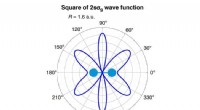
* The wave-particle duality: The key insight came from experiments like the double-slit experiment. When electrons (which we think of as particles) are fired at a screen with two slits, they produce an interference pattern on the other side, just like waves do. This interference pattern is a signature of wave behavior and cannot be explained by classical physics.
* Other evidence: Several other experiments have confirmed the wave-like nature of matter, including:
* Electron diffraction: Electrons can diffract, just like light waves do when they pass through a narrow opening.
* De Broglie wavelength: Louis de Broglie proposed that any moving particle has an associated wavelength, given by the equation λ = h/p, where h is Planck's constant and p is the momentum of the particle.
So, How Does Matter Behave as a Wave?
The real answer lies in the weirdness of quantum mechanics. It's not that matter is actually a wave or a particle, but rather that it exists in a state of superposition. This means that matter can exist in multiple states simultaneously, and its wave-like or particle-like behavior depends on how we observe it.
The Bottom Line:
* Matter exhibits both wave-like and particle-like properties.
* The way we observe matter determines which behavior we see.
* This duality is a fundamental aspect of quantum mechanics.
It's important to note that we're not talking about a simple switch between particle and wave behavior. It's more like a spectrum. Sometimes matter behaves more like a wave, and sometimes it behaves more like a particle. The exact nature of its behavior depends on the specific situation and the way it's being observed.
This concept is one of the most mind-bending aspects of quantum mechanics and continues to be a source of fascination and research.