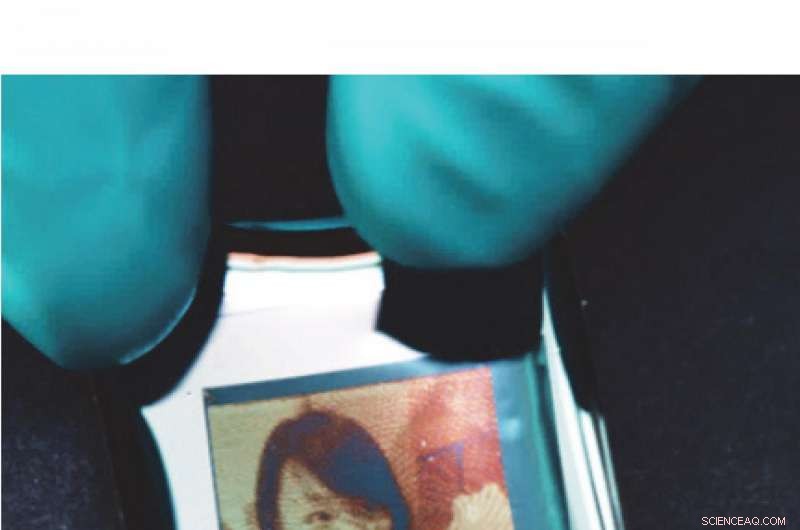
Structural color laser printing of a photo demonstrating that a highly saturated cyan, magenta, and yellow (CMY) combination successfully leads to a half-toned black color. Credit: Technical University of Denmark
(Phys.org)—A team of researchers at the Technical University of Denmark has developed a way to print colors onto a surface without using ink and which will not fade. In their paper published in the open-access journal Sciences Advances, the group describes the inspiration for their approach, how it works, their results and the one thing they still need to solve before their technique can be industrialized.
In nature, color differentiation is created in two different ways. One is through pigments, which are like those in our skin—the other is by the creation of tiny, unique structures on surfaces such as those in bird feathers, fish scales and many other organisms. With pigments, the material is actually colored. With color structuring, color derives from microscopic structures on the surface of an object that redirect frequencies of light. Up till now, copy machines have used pigments in ink to create colors on a page. In this new effort, the researchers have worked out a way to create coloring on a surface using a laser to melt a very thin layer of germanium, a semimetal.
The idea behind the printing technique is to heat the germanium to melt it in certain ways that leave certain tiny shapes behind after cooling—these shapes reflect light in a desired way. To achieve this feat, a very thin layer of germanium is laid down over a material that has an array of microscopic polymer columns on it. The laser is then used to melt the germanium in ways that correspond to desired colors. The columns are so small that the process can print images at 100,000 dpi, suggesting much higher resolution than can be obtained using pigmenting. The result, the researchers note, is a color image that, like bird feathers, will not fade, because it is not created using pigments. They suggest the technique might be useful for printing security patterns or watermarks.
There is one glaring problem with the technique, the researchers note—currently, it does not allow for printing the color green, because green resides in the middle of the spectrum—printing it would require laser building a structure that is able to absorb both red and blue light. They report that they are currently working on ways to build more complicated nanostructures to address the problem.
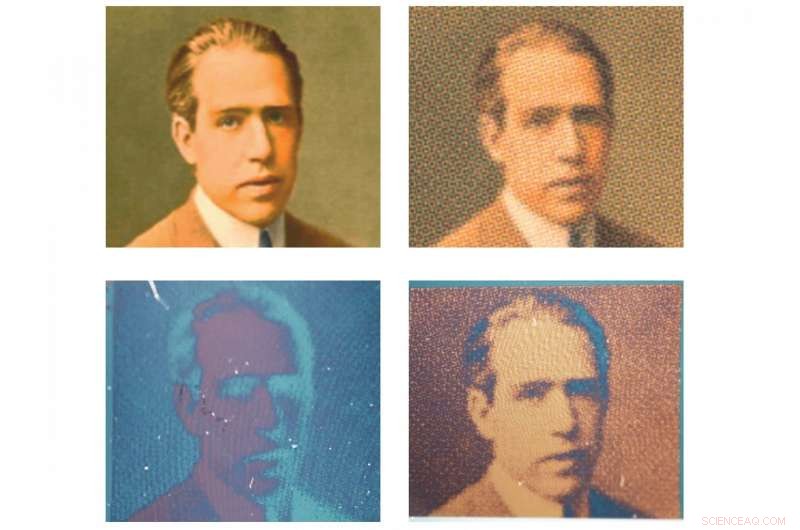
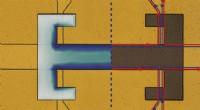
The cyan, magenta, and yellow (CMY) half-toning process showing the original image, the half-toned original image, a magenta color on a cyan background and a laser-printed final image. Credit: Technical University of Denmark
© 2017 Phys.org