Here's a breakdown:
What are electromagnetic waves?
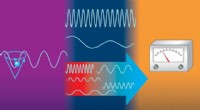
Electromagnetic waves are disturbances that travel through space at the speed of light. They are made up of oscillating electric and magnetic fields that are perpendicular to each other and to the direction of propagation.
The spectrum's different regions:
The electromagnetic spectrum is divided into different regions based on the frequency and wavelength of the radiation. These regions are:
* Radio waves: Have the longest wavelengths and lowest frequencies. Used for communication, broadcasting, radar, and medical imaging.
* Microwaves: Shorter wavelengths than radio waves, used for cooking, communications, and radar.
* Infrared radiation: Shorter wavelengths than microwaves, felt as heat. Used in thermal imaging, remote sensing, and optical fibers.
* Visible light: The only portion of the electromagnetic spectrum that humans can see. This region is further divided into different colors: red, orange, yellow, green, blue, indigo, and violet.
* Ultraviolet radiation: Shorter wavelengths than visible light, can be harmful to living organisms but also used for sterilization and medical treatment.
* X-rays: Even shorter wavelengths than ultraviolet radiation, used in medical imaging, security scanning, and material analysis.
* Gamma rays: The shortest wavelengths and highest frequencies, extremely energetic and used in medical imaging, cancer treatment, and industrial applications.
Key properties:
* Frequency: The number of waves that pass a point in a given amount of time.
* Wavelength: The distance between two consecutive crests or troughs of a wave.
* Energy: The amount of energy carried by a wave.
Relationship between frequency, wavelength, and energy:
* Frequency and wavelength are inversely proportional. This means that as frequency increases, wavelength decreases, and vice versa.
* Frequency and energy are directly proportional. This means that as frequency increases, energy increases, and vice versa.
Applications:
The electromagnetic spectrum has countless applications in science, technology, and everyday life. Some examples include:
* Communication: Radio waves, microwaves, and infrared radiation are used for communication purposes.
* Medicine: X-rays and gamma rays are used for medical imaging and treatment.
* Astronomy: Astronomers use different parts of the electromagnetic spectrum to study celestial objects.
* Remote sensing: Infrared radiation and microwaves are used to monitor the Earth's environment.
* Industrial applications: X-rays and gamma rays are used for non-destructive testing and material analysis.
The electromagnetic spectrum is a fascinating and powerful tool that allows us to understand and interact with the world around us.