Understanding Momentum
Momentum (p) is a measure of an object's mass in motion. It's calculated by:
* p = mv
* where 'm' is the mass and 'v' is the velocity.
The Collision
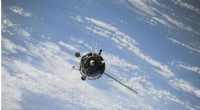
Since the spaceships stick together after the collision, we're dealing with an inelastic collision. In an inelastic collision, kinetic energy is not conserved, but momentum *is* conserved.
Calculations
1. Initial Momentum of Spaceship 1:
* p1 = m1 * v1 = 300 kg * 0 m/s = 0 kg*m/s
2. Initial Momentum of Spaceship 2:
* p2 = m2 * v2 = 300 kg * 6 m/s = 1800 kg*m/s
3. Total Initial Momentum:
* p_total = p1 + p2 = 0 kg*m/s + 1800 kg*m/s = 1800 kg*m/s
4. Final Momentum:
* Since momentum is conserved, the final momentum of the combined spaceship is equal to the total initial momentum.
* p_final = 1800 kg*m/s
Answer:
The combined momentum of the two spaceships after the collision is 1800 kg*m/s.