Here's a breakdown of when light behaves like a wave and when it behaves like a particle:
Wave-like behavior:
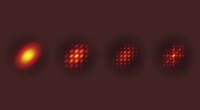
* Diffraction and Interference: Light bends around obstacles (diffraction) and waves from different sources can interact to produce interference patterns (bright and dark bands), which are characteristic of waves. This is seen in phenomena like the colors in soap bubbles, the operation of lasers, and the diffraction of light through narrow slits.
* Polarization: Light can be polarized, meaning its oscillations are restricted to a specific plane. This is another wave property, and is used in polarized sunglasses and LCD screens.
* Speed: Light travels at a constant speed in a vacuum, regardless of the frequency or wavelength, which is a characteristic of waves.
Particle-like behavior:
* Photoelectric Effect: When light shines on certain metals, electrons are emitted. The energy of these electrons is directly proportional to the frequency of the light, not its intensity, suggesting light is composed of packets of energy called photons.
* Compton Scattering: When X-rays interact with matter, they can lose energy and change direction. This can be explained by treating light as photons that collide with electrons, transferring energy and momentum.
* Blackbody Radiation: The way objects emit light at different temperatures can be explained by treating light as quantized packets of energy (photons).
The key takeaway:
Light's behavior depends on how we interact with it or observe it. In some experiments, its wave properties are more prominent, while in others its particle properties are more apparent. It's not that light "chooses" to be a wave or a particle, but rather that it exhibits both aspects simultaneously, making it a fascinating and complex phenomenon.