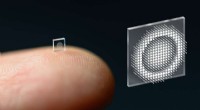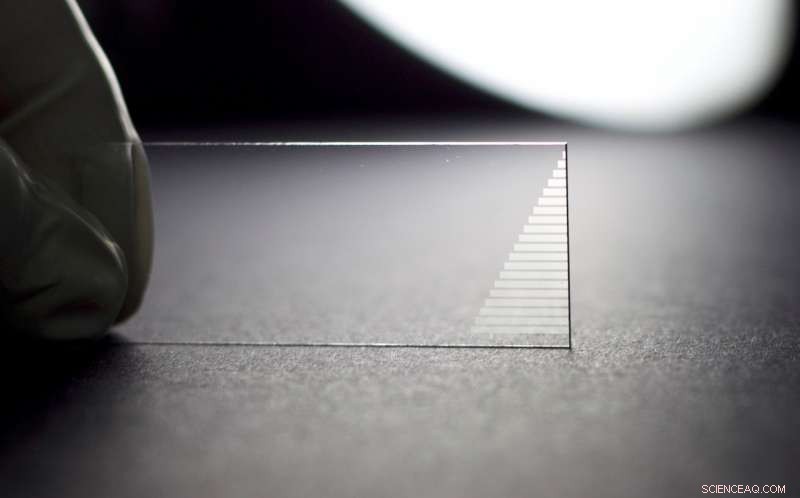
The quantum chip with waveguide structures visible. Credit: Xianmin Jin
A team of researchers from Shanghai Jiao Tong University and the University of Science and Technology of China has developed a chip that allows for two-dimensional quantum walks of single photons on a physical device. In their paper published on the open access site, Science Advances the group describes the chip and why they believe developing it was important.
Quantum walks are the quantum version of classical random walks, which are a mathematical means for describing a natural random walk, e.g., simply wandering around randomly. To describe such walks, mathematicians and computer scientists use probability distribution grids that show a current position and possible next steps. Quantum walks are used to build models that depict randomly grown, sophisticated and complex networks such as the human neural network. They can also be used to create networks for actual use in applications, and might one day be used in quantum-based robots.
As the researchers note, a quantum computer should provide exponential advantages over classical systems due to their nature. To that end, scientists have been working to implement quantum walks in a physical machine as part of developing a truly useful quantum computer. In this new effort, the researchers report that they have developed a chip that carries out quantum walks on a two-dimensional 49x49 grid—the largest created so far by any team.
The three-dimensional chip, the team reports, was created using a technique called femtosecond writing. It uses the external geometry of photonic waveguide arrays as a means for carrying out the quantum walks using a single photon. They note also that they tested the chip by observing patterns and variance profiles and comparing them to simulation studies. They suggest further that in addition to making progress toward a truly useful quantum computer, the chip could also be used to boost the performance of analog quantum computing or quantum simulators.
If researchers can create quantum computers with very large, or even unlimited size grids, it might be possible to create and use networks as complex as the human nervous system.

The quantum chip with waveguide structures visible. Credit: Xianmin Jin
© 2018 Phys.org