1. Development of Photomultipliers and Photodiodes:
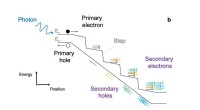
* Photomultipliers: These devices, based on the photoelectric effect, are extremely sensitive light detectors. They amplify faint light signals by using the photoelectric effect to release electrons, which are then cascaded through a series of dynodes. This makes them vital for applications like:
* Astronomy: Detecting faint starlight and distant galaxies.
* Medical imaging: PET scans and other diagnostic tools.
* Scientific research: Measuring light intensity in various experiments.
* Photodiodes: These devices convert light into electrical current, making them essential for:
* Solar cells: Converting sunlight into electricity.
* Optical communication: Detecting light pulses in fiber-optic cables.
* Optical sensors: Measuring light intensity in various applications, like light meters.
2. Understanding Light's Quantum Nature:
* Einstein's explanation of the photoelectric effect solidified the concept of light as both a wave and a particle (photons). This led to the development of quantum mechanics, which revolutionized our understanding of the universe at the smallest scale.
3. Advancements in Spectroscopy and Materials Science:
* Spectroscopy: The photoelectric effect is used in techniques like X-ray photoelectron spectroscopy (XPS) to analyze the elemental composition and chemical states of materials. This is crucial for:
* Materials science: Developing new materials and understanding their properties.
* Chemistry: Studying chemical reactions and analyzing molecular structures.
* Materials Science: Understanding the photoelectric effect has led to the development of new materials with specific light-absorbing properties, used in:
* Solar panels: More efficient energy harvesting from sunlight.
* Light-emitting diodes (LEDs): More energy-efficient lighting.
4. Impact on Other Fields:
* Electronics: Understanding the photoelectric effect has led to advancements in phototransistors, which are used in various electronic devices.
* Medical Technology: Photodynamic therapy, a cancer treatment that uses light and photosensitive drugs, is based on the photoelectric effect.
In summary, Albert Einstein's explanation of the photoelectric effect was a pivotal moment in physics, leading to the development of essential technologies in numerous fields. Our modern world, from energy production to medical diagnostics and beyond, relies heavily on the principles discovered through this groundbreaking work.