1. Transverse Waves:
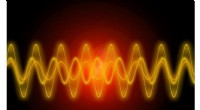
* Particles move perpendicular to the direction the wave travels.
* Imagine a rope tied to a wall. If you shake the rope up and down, you create a transverse wave. The rope itself (made of particles) moves up and down, while the wave travels horizontally along the rope.
* Examples: Light waves, electromagnetic waves, waves on a string.
2. Longitudinal Waves:
* Particles move parallel to the direction the wave travels.
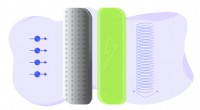
* Imagine a slinky. If you push one end of the slinky forward and back, you create a longitudinal wave. The slinky coils move back and forth in the same direction as the wave travels.
* Examples: Sound waves, pressure waves, seismic waves.
Important Notes:
* The particles themselves don't travel with the wave. They oscillate or vibrate around a fixed point.
* The wave transfers energy, not matter. This means the particles don't move along with the wave; they just transfer energy from one to the next.
Visualizing Particle Motion:
* Transverse wave: Think of the up-and-down movement of a buoy on a lake.
* Longitudinal wave: Imagine a train of cars where each car moves slightly forward and backward, causing a compression and expansion in the train.
By understanding these key differences, you can grasp the essential nature of wave motion and how particles behave within them.