Angular Momentum:
* Definition: A measure of an object's tendency to resist changes in its rotation. It's a fundamental property of any rotating object.
* Physical Origin: Arises from the mass distribution and its motion around an axis.
* Units: kg m²/s
* Examples: The Earth's rotation around its axis, a spinning top, an electron orbiting the nucleus.
Magnetic Moment:
* Definition: A measure of the strength and orientation of a magnetic dipole, which arises from moving electric charges.
* Physical Origin: Arises from the movement of charged particles, either in an atomic current loop or by the spin of the particles themselves.
* Units: Am² (Ampere-meter squared)
* Examples: A bar magnet, a current loop in a wire, an electron's spin.
Key Differences:
* Nature: Angular momentum is a purely mechanical quantity, while magnetic moment originates from electromagnetic interactions.
* Source: Angular momentum is caused by the distribution and motion of mass, while magnetic moment is caused by the motion of charged particles.
* Units: They have different units, reflecting their different physical origins.
Connection:
While distinct, magnetic moment and angular momentum are closely related in some cases, particularly in the context of charged particles.
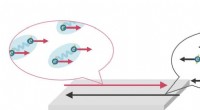
* Spin Magnetic Moment: Electrons and other fundamental particles have an intrinsic angular momentum called spin. This spin generates a magnetic moment, known as the spin magnetic moment.
* Orbital Magnetic Moment: When a charged particle orbits around a nucleus, it creates an orbital angular momentum, which in turn gives rise to an orbital magnetic moment.
In summary, angular momentum is a fundamental property of rotation, while magnetic moment is a property related to the movement of charged particles. While they are distinct, they can be related in the case of charged particles, where spin and orbital angular momentum directly contribute to magnetic moment.