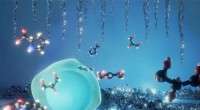
* Monomers: The basic building blocks of the polymer chain are small molecules called monomers. In rubber bands, the most common monomer is isoprene, a hydrocarbon molecule.
* Polymer Chains: Thousands of isoprene molecules link together to form long, flexible chains. Imagine them like spaghetti noodles, but even longer and thinner.
* Cross-links: These chains are not just loose, they are connected to each other at various points through cross-links. These links act like bridges, holding the chains together and giving the rubber its strength and elasticity.
* Structure: These chains are arranged in a tangled, random way. This randomness is crucial for the rubber band's ability to stretch and recoil.
How it works:
When you stretch a rubber band, you're pulling the polymer chains apart. The cross-links prevent the chains from completely separating, but they allow for a significant amount of stretching. When you release the tension, the chains snap back to their original, tangled configuration, causing the rubber band to return to its original shape.
Key points to remember:
* Flexibility: The long, flexible polymer chains allow the rubber band to stretch.
* Cross-linking: The cross-links provide strength and prevent the rubber band from tearing.
* Randomness: The random arrangement of chains gives the rubber band its elasticity.
This structure and behavior explain why rubber bands can be stretched, can return to their original shape, and are relatively strong.