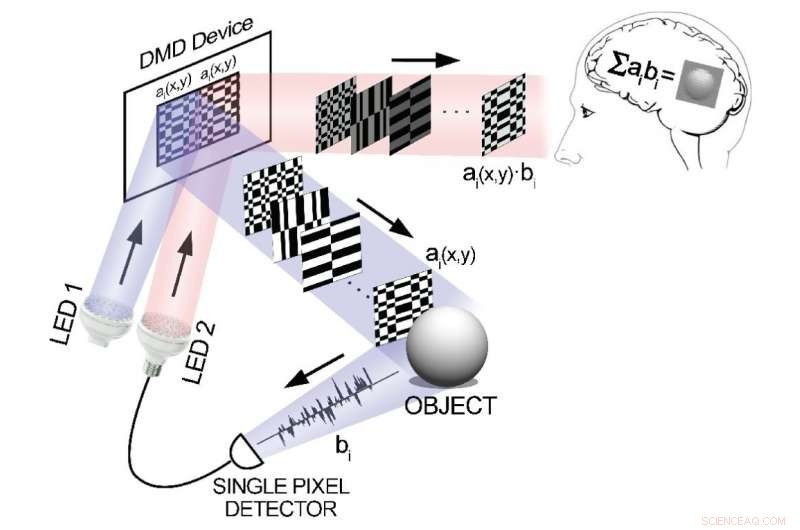
Experimental ghost imaging with the human eye. LED1 illuminates the DMD which projects Hadamard patterns at 20 kHz onto an object. The reflected light is collected by a single-pixel detector. The output modulates the intensity of LED2 which also illuminates the DMD and is subject to the same patterns as LED1. The intensity-weighted Hadamard patterns are viewed on the DMD by eye or projected onto a screen. Human vision integrates over the patterns when these are projected for much shorter durations than the eye’s persistence time. As a result, although only black and white patterns are projected, the eye effectively perceives a “ghost” image of the object. Credit: arXiv:1808.05137 [q-bio.NC] https://arxiv.org/abs/1808.05137
A team of researchers in the U.K. has found that the human eye and brain are together capable of seeing "ghosted" images. The researchers have published a paper describing their work on the arXiv preprint server.
Physicists have found that it is possible to create ghost images with a technique using light to make an image without reflecting it off the original object. The technique is called "ghosting," and is of interest to optics research. It involves lighting an object with a structured light field and recording the light that is reflected off the object with a bucket detector. Meanwhile, a second light field is modulated using a predesigned pattern and is projected onto a detector. The detector records and integrates the light to create an image. In this new effort, the researchers found that the human eye and brain can work together to perform the function of the second detector, and in so doing, can see an image created by photons that never actually touched the original object.
The experiment was conducted as usual, but instead of using the spatially resolved detector, a human being was positioned to look at the screen where the light was being projected. The human volunteers were exposed to random bits of light which, when combined together over time, formed an image—in the experiments, the image was the famous photograph of Albert Einstein sticking out his tongue. To find out if such an arrangement could work, the volunteers were situated in such a way as to allow them to adjust the pacing of the patterns projected onto a screen in front of them.
The researchers report that the pacing of the projections started out slowly, but as each of the volunteers used a device to speed up the time between each display, they eventually came to a point that they could make out the image—at 20 kilohertz. They further report that their experiments demonstrate an entirely new form of human visual phenomenon, and because of that, opens a new field of optical study.
© 2018 Phys.org