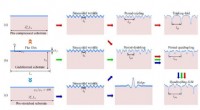
Here's a breakdown:
* Wavelength: The distance between two consecutive crests or troughs of a wave.
* Obstacle/Opening Size: The size of the object the wave interacts with.
Key Principles:
* Larger Wavelength, More Diffraction: Waves with longer wavelengths diffract more significantly. This is because the wave has more time to spread out around obstacles or openings.
* Smaller Obstacle/Opening, More Diffraction: When the size of the obstacle or opening is comparable to or smaller than the wavelength, the wave will diffract more dramatically. The smaller the opening, the greater the spread of the wave after it passes through.
* Larger Obstacle/Opening, Less Diffraction: When the size of the obstacle or opening is significantly larger than the wavelength, the wave will diffract less. The wave tends to travel in a straight line.
Examples:
* Light Waves:
* A narrow slit (smaller than the wavelength of visible light) produces a noticeable diffraction pattern.
* A wide opening (much larger than the wavelength) allows light to pass through with minimal diffraction.
* Sound Waves:
* Sound waves can diffract around corners, allowing you to hear people even if they are hidden around a corner.
* A very small opening (like a keyhole) will significantly diffract sound waves, making it hard to hear sounds from the other side.
Mathematical Representation:
The amount of diffraction is quantified by the Fraunhofer Diffraction Formula, which relates the diffraction angle to the wavelength and the size of the obstacle or opening.
In Conclusion:
The relationship between wavelength and the size of the obstacle/opening is the primary factor determining how much a wave will diffract. Longer wavelengths and smaller openings lead to more significant diffraction.