1. Solids:
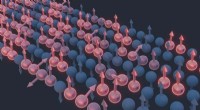
* Particle arrangement: Tightly packed, in a fixed, regular arrangement (lattice structure).
* Particle movement: Vibrate in fixed positions, with minimal translational movement.
* Forces between particles: Strong attractive forces hold them together.
Result: Solids have a definite shape and volume. They are rigid and incompressible.
2. Liquids:
* Particle arrangement: Closely packed, but less ordered than solids.
* Particle movement: Vibrate and move around freely, able to slide past each other.
* Forces between particles: Weaker attractive forces than solids, allowing for fluidity.
Result: Liquids have a definite volume but take the shape of their container. They are fluid and relatively incompressible.
3. Gases:
* Particle arrangement: Widely spaced, with no fixed arrangement.
* Particle movement: Move rapidly and randomly in all directions.
* Forces between particles: Very weak attractive forces, allowing for free motion.
Result: Gases have no definite shape or volume. They fill their container and are easily compressible.
4. Plasma:
* Particle arrangement: Similar to gases, but with some ionized atoms.
* Particle movement: Very fast and random motion, with some free electrons.
* Forces between particles: Complex interactions due to charged particles.
Result: Plasma is a highly energetic state of matter that can conduct electricity and be affected by magnetic fields.
Key Factors Affecting Behavior:
* Temperature: Higher temperature increases particle kinetic energy, leading to more movement and weaker interparticle forces.
* Pressure: Increased pressure forces particles closer together, affecting interparticle interactions.
* Attractive Forces: The strength of interparticle forces determines how tightly particles are bound.
In summary: The movement, arrangement, and interactions of particles determine the physical properties of matter in its various states. Understanding this relationship allows us to predict how matter will behave under different conditions.