1. Photoelectric Effect: The wave model of light couldn't explain the photoelectric effect. This effect observed that electrons are ejected from a metal surface when light shines on it, but only if the light has a frequency above a certain threshold. The wave model predicted that the energy of light should depend only on its intensity, not its frequency. However, experiments showed that the energy of ejected electrons depended on the frequency of light, not its intensity. This led to the development of the idea of light behaving as a particle (photon) with energy proportional to its frequency.
2. Blackbody Radiation: Classical physics using the wave model predicted that a blackbody (an object that absorbs all light) should radiate an infinite amount of energy at high frequencies. This was clearly not observed in reality. Max Planck explained the observed spectrum by proposing that energy was quantized, meaning it could only exist in discrete packets (photons). This concept contradicted the wave model.
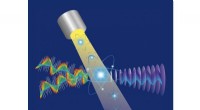
3. Compton Scattering: This phenomenon involves the scattering of X-rays by electrons, where the X-rays lose energy and change direction. The wave model could not explain the shift in wavelength observed in the scattered X-rays. The particle nature of light was needed to explain the effect, with photons colliding with electrons and losing energy.
These deficiencies ultimately led to the development of the wave-particle duality of light, where light exhibits both wave-like and particle-like properties depending on the situation.