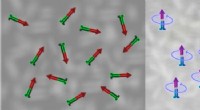
1. Quantum Mechanics:
* Zero-Point Energy: Even in the emptiest space, quantum mechanics dictates the existence of "zero-point energy," a fluctuating energy field that causes virtual particle-antiparticle pairs to constantly pop in and out of existence. These particles, even if fleeting, contribute to a non-zero density in the vacuum.
* Heisenberg Uncertainty Principle: This principle states that we cannot know both the exact position and momentum of a particle simultaneously. This inherent uncertainty means we can never truly know if a space is completely empty, as there's always a chance that particles might exist in the region we are observing.
2. Cosmic Background Radiation:
* The universe is filled with a faint background radiation leftover from the Big Bang. This radiation, while extremely low in energy, represents a constant influx of particles and energy that permeate all space.
3. Gravitational Fields:
* Even if we could somehow eliminate all particles from a given space, gravitational fields from distant objects would still permeate the region. Gravity itself can be considered a form of energy, which would technically prevent a perfect vacuum.
4. Practical Limitations:
* In laboratory settings, it's impossible to create a perfect vacuum due to limitations in technology. Even the most advanced vacuum pumps cannot remove all particles from a chamber.
5. Theoretical Implications:
* The concept of a perfect vacuum is purely theoretical and serves as a useful starting point for certain calculations and thought experiments. However, it is not a physically achievable state.
In summary:
A perfect vacuum, devoid of all matter and energy, is impossible due to the fundamental laws of quantum mechanics, the presence of background radiation, and the influence of gravitational fields. The concept of a "perfect vacuum" is a useful theoretical construct, but in reality, all spaces will contain some level of particles and energy.