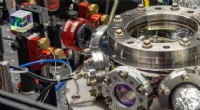
An Atomic Force Microscope (AFM) is a powerful tool that allows scientists to image and manipulate matter at the nanoscale, meaning at the level of individual atoms and molecules.
Here's how it works:
1. The Tip: A sharp, needle-like tip is attached to a tiny cantilever, a flexible beam. This tip is usually made of a hard material like silicon or diamond.
2. The Cantilever: The cantilever is designed to bend or deflect when it interacts with the surface being scanned.
3. The Scanner: The tip is attached to a scanner that moves it across the surface in a controlled pattern, similar to a record player's arm.
4. The Sensor: A laser beam is shone onto the back of the cantilever. As the cantilever bends, the reflected laser beam moves, which is detected by a sensor.
5. The Feedback Mechanism: The sensor signals are used to create a feedback loop that adjusts the tip's height to maintain a constant force between the tip and the surface.
6. The Image: The movement of the tip, and the corresponding adjustments made by the feedback loop, are recorded and used to construct a detailed topographic image of the surface.
What makes AFM unique:
* High Resolution: It can achieve atomic-scale resolution, allowing scientists to visualize individual atoms and molecules.
* Versatility: AFM can be used to study a wide range of materials, including metals, polymers, ceramics, and biological samples.
* Surface Sensitivity: It can provide detailed information about the surface topography, including surface roughness, defects, and even the arrangement of atoms.
* Manipulative Capabilities: Besides imaging, AFM can also be used to manipulate materials at the nanoscale, such as pushing, pulling, or cutting individual molecules.
Applications of AFM:
* Materials Science: Studying the surface properties of materials, understanding crystal growth, and developing new nanomaterials.
* Biology and Medicine: Investigating the structure of proteins, DNA, and cells, and developing new diagnostic and therapeutic tools.
* Electronics: Studying the fabrication and performance of nanodevices, such as transistors and memory chips.
* Data Storage: Developing new high-density data storage technologies.
Overall, the AFM is a powerful tool that allows scientists to explore the world of the very small, revealing the intricate details of matter at the atomic level.