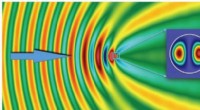
Here's what that means:
* Retrograde: The particle motion is in the opposite direction to the wave propagation. Imagine a wave moving to the right, and the particles are moving in a small circle or ellipse, but they're rotating in a clockwise direction (opposite to the wave's direction).
* Elliptical: The motion of the particles isn't a perfect circle. It's more like an elongated circle, or an ellipse, with the major axis of the ellipse being roughly parallel to the direction of wave propagation.
To visualize this:
1. Imagine a wave traveling across the surface of water.
2. Now, imagine a small cork floating on the water's surface.
3. As the wave passes, the cork will move in a small, clockwise circle or ellipse. The cork will move slightly forward as the wave passes, but its primary motion is a circular or elliptical rotation in the opposite direction to the wave's movement.
Why is this motion important?
Rayleigh waves are surface waves, meaning they travel along the surface of a material. Their retrograde elliptical motion is what causes the damage associated with earthquakes. This motion causes the ground to shake and roll, which can be very destructive to buildings and infrastructure.
Let me know if you'd like more information about Rayleigh waves!