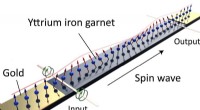
Here's why:
* Transverse waves: The oscillations of the medium are perpendicular to the direction the wave travels. Imagine shaking a rope up and down. The wave travels along the rope, but the rope itself moves up and down (perpendicular to the wave's direction).
* Longitudinal waves: The oscillations of the medium are parallel to the direction the wave travels. Think of a slinky. If you push and pull one end, the compression and expansion (the wave) travels along the slinky. The slinky itself is moving back and forth (parallel to the wave's direction).
Examples of Transverse Waves:
* Light waves: Light is a transverse wave, and its oscillations are electric and magnetic fields, which are perpendicular to the direction the light travels.
* Waves on a string: As mentioned above, when you shake a rope, the wave travels along the rope, but the rope itself moves perpendicular to the wave's direction.
Examples of Longitudinal Waves:
* Sound waves: Sound travels through air as compressions and rarefactions, which are parallel to the direction the sound wave travels.
* Seismic waves: Some types of seismic waves, like P-waves, are longitudinal, where the ground moves back and forth in the same direction the wave travels.