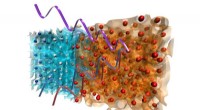
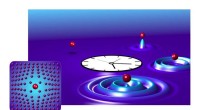
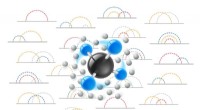
* Atomic Theory: The fundamental building blocks of matter are atoms. Atoms are tiny, indivisible particles that combine to form molecules and larger structures. There is empty space between these atoms.
* Quantum Mechanics: Quantum mechanics describes the behavior of matter at the atomic and subatomic levels. It shows that matter exists in discrete packets of energy, called quanta. This means that matter is not infinitely divisible.
* Evidence: Experiments like the scattering of alpha particles by gold foil (Rutherford's experiment) demonstrated the existence of a nucleus within the atom, implying an empty space within the atom.
Examples of matter being discrete:
* Water: Water is made of H2O molecules. There are gaps between these molecules, making water a fluid.
* Metals: Metals are made of atoms arranged in a lattice structure. Although the atoms are closely packed, there is still empty space between them.
* Gases: Gases have very large spaces between their atoms or molecules. This allows them to be compressed easily.
However, matter can appear continuous at macroscopic scales. This is due to the vast number of atoms involved. For example, a piece of wood appears to be a solid continuous material, but it is actually made up of a huge number of atoms and molecules.
In conclusion:
While matter can appear continuous at large scales, at a microscopic level, it is made up of discrete particles (atoms and molecules) separated by empty space. The concept of "continuous" matter is a simplification that works for many practical purposes, but it is not a fundamental truth about the nature of matter.